G. Mohan Gopal
Few questions are of greater importance in a democracy than the process of making laws that bind us – who decides what law is to be made? who has a seat at the table? Whose voice is heard? Who determines the content of law?
In “Legislative Drafting – Shaping the Law for the New Millennium”, T.K. Viswanathan, India’s Union Law Secretary and our most experienced draftsman of Central laws, gives us a rare glimpse into the inside story on how the laws that bind us are drawn up.
Mr. Viswanathan’s book focuses on the technical aspects of drafting of legislation. It is the second edition of the well known 1980 treatise The Drafting of Laws, written by the late G.R. Rajagopaul, the first person to serve as Legislative Secretary of India after Indian independence. Mr. Viswanathan thoroughly updates the original edition and adds four new chapters, two of which are of particular contemporary importance – one on the complexity of legislation; and another on plain language drafting. The book is a masterful blend between theory and practice on legislative drafting. It brings together state of the art national and international thinking on the knowledge and skills required of legislative draftsmen; detailed “how to” guidance on writing laws; and common errors in drafting. The book makes a strong case for adopting in India the worldwide demand for plain language drafting and for reducing complexity in the legislation. It deals exhaustively with related issues such as statutory interpretation and the General Clauses Act. The book is rich in law, humour and anecdotes, reflecting the sparkling personality of the eminent author. The quality of the writing is, however, not fully matched by the quality of editing. Notwithstanding that, this excellent book should be mandatory reading for all legislative draftsmen in our country as it is a comprehensive compendium of the law and practice on legislative drafting.
However, what is even more interesting than the valuable ground the book covers is what it reveals – the democratic deficit in the current process for preparing legislation in India.
The chapter “Preparation and Passing of Bills – Indian Scene” reveals the absence of any systematic role for public participation in the legislative process. The process of preparing legislation is today an opaque process that takes place behind closed doors in the fortress that Parliament has become. People at large have little knowledge and no voice about the Bills that are under consideration. In contrast, advanced market economies have all come to incorporate strong public participation in the preparation of legislation so as to improve the quality and effectiveness of laws.
Extensive and systematic public participation in the preparation of legislation is especially important because the content of law is today heavily and unduly influenced by corporate lobbying, technocratic inputs and global institutions. Legislators and legislative institutions cannot any longer be relied upon as the sole guarantor of the public interest in the legislative process. Government should establish “public information centers” in every village in which draft bills, translated into local language is made available. Adequate time should be provided for public comment and debate. The increasing number of regulations made by governmental agencies also needs to be brought within the framework of public participation.
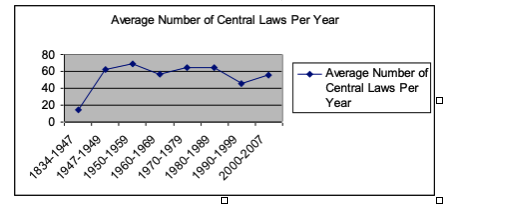
In the hands of an authoritarian regime legislation can be an instrument of oppression. In the hands of a democratic society, however, legislation is a powerful instrument of radical social transformation. The crucial importance of democratic factors in influencing the quantity and quality of legislation is evident in our own history. The largest number of laws made in a single year in independent India was in 1956 (105 laws) – when Parliament, under Nehru, was pursuing radical social and economic reform in India (including enacting the Hindu Code). Likewise, the twenty years between 1969 and 1989 (when 1289 laws were enacted) was the most prolific period of legislative activity in India. In contrast, the lowest number of central acts made in any decade after independence was in the decade of the 1990s — as the State took an increasingly laissez-faire role.
A democratic Indian parliament has made an average of some 60 laws per year between 1947 and 2007. In contrast, to run an autocratic regime, the British colonial authorities needed to enact only an average of 15 central laws per year ( in the 113 years between 1834 (when for the first time the Charter Act 1833 vested legislative power in the Governor General in Council and 1947).
It is therefore of vital importance that the process for the preparation of legislation be consciously democratized and appropriate structures be built into the process for extensive public participation. Mr. Viswanathan’s book should not only provide valuable technical guidance to draftsmen – it should also trigger a public debate on eliminating the democratic deficit in the preparation of our laws.

 Prof. G. Mohan Gopal