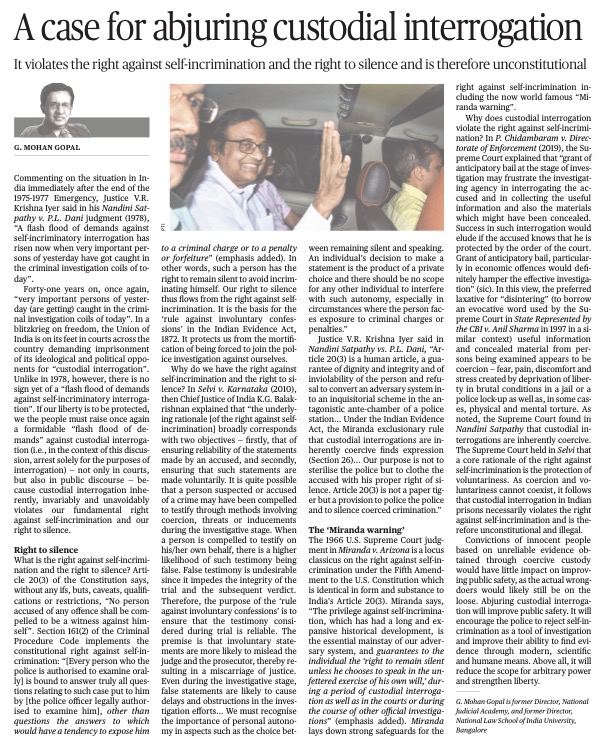
CONTEMPT UNBOUND: The Supreme Court on Prashant Bhushan

Prof. G. Mohan Gopal

The August 14, 2020 finding of a three-judge bench of the Supreme Court in In Re Prashant Bhushan & Anr.,Alleged Contemnor that, by sending two tweets, Advocate Prashant Bhushan was engaged in an “attempt to shake the very foundation of constitutional democracy” in India by “destabilising” the Indian judiciary” is entirely unconvincing on facts and on law. It comes across as hyperbole unbecoming of the dignity, dispassionate sobriety and reliable precision that has come to be expected from one the world’s greatest Apex courts.

A charge that Mr. Bhushan has attempted to shake the very foundation of constitutional autocracy in India would, on the other hand, be credible. This, he has done. And there is every reason and every urgency for all of us to join him in attacking, through peaceful and legal means, “the very foundation of constitutional autocracy” in our country.

Autocracy has, after all, been our norm since time immemorial. It is an ancient tradition for us. Democracy, on the other hand, is a new and nascent experiment, forced on an unwilling elite by a mass struggle for freedom. The language and culture of autocracy comes easily to us — a justice system in which the “king’s law” is conveyed by courts to an obedient people; the law is enforced with an “iron hand” which, with “firmness”, “strikes” those who “attack” the “majesty” of courts (words in quotes are from the judgment).

Autocracy is still seen by those who have faith in the ancien regime as the best — in fact, the only — way to establish order and achieve progress in our “chaotic” country. Returning to a Hindu monarchy — the best system according to Golwalkar — may not any longer be an option in today’s world. However, for them, a ‘constitutional autocracy’ founded in majoritarian religion — ‘constitutional’ but in name — is a necessary and feasible second-best option. Keep a hollowed-out Constitution nominally in the frame, but photoshop democracy out of it.

In this context, Advocate Prashant Bhushan’s powerful, persistent, fearless and effective campaigns against autocracy have become intolerable to autocrats in all branches of the State, and in our larger society. He must be stopped. Criminal contempt of court (“scandalizing” the court) becomes an appropriate tool to stop him because criminal contempt power is, jurisprudentially and procedurally, an unruly horse providing vast unchecked discretion to the judiciary to impose criminal conviction and criminal punishment on those who challenge the system, free of normal checks and balances. Many traditional grounds on which a person arrayed for other crimes can defend himself or herself are disabled when a Court unsheathes its awesome power of criminal contempt.

This is what enabled this case to race from the communication of the first tweet to conviction in 48 days — lightning speed that even Chinese criminal courts would envy — while one of India’s top lawyers was reduced to the role of a helpless spectator of his own trial and conviction, with little meaningful opportunity to defend himself. The Attorney General was given short shrift — even an Attorney General who is not in the least expected to defend Bhushan’s, or any one’s, free speech. Converting a matter initiated by a petition into a suo moto proceeding, making the cause its own, the judiciary became the accuser and the judge.

The judgment in In Re Prashant Bhushan is per incuriam. Three legal errors deserve to be highlighted in particular.

(1) the supreme court lacks power over contumacious speech when not acting under the contempt of courts act

The judgment says (paragraph 18), “It has been held, that the Court is vested with the constitutional powers [under Articles 129 and 142] to deal with the contempt and Section 15 is not the source of the power to issue notice for contempt…the Court is exercising its inherent powers to issue notice for contempt. It is equally well settled, that once the Court takes cognizance, the matter is purely between the Court and the contemnor. The only requirement is that, the procedure followed is required to be just and fair and in accordance with the principles of natural justice.”

This has major implications for the powers of the Supreme Court. Here’s why.

Article 19(1)(a) of the Constitution guarantees that, “All citizens shall have the right to freedom of speech and expression”. For an autocrat, this may be one of the most hated provisions of the Constitution. It is, however, the heart and soul of a democracy — a most precious right that can be restricted only in the rarest of rare cases, subject to strong safeguards.

Under Article 19(2), our precious right to freedom of speech and expression may be restricted only by legislation made by the State imposing “reasonable restrictions” in the interests of nine enumerated considerations, one of which is contempt of court.

The Constitutional scheme is clear. Under Article 19(2), only “reasonable restrictions” may be imposed on Article 19(1)(a) freedom by a legislature by enacting legislation. Restrictions cannot be imposed on Article 19(1)(a) freedoms directly by the judiciary or the executive. The judiciary is only to interpret and apply the restrictions imposed by the legislature.

Accordingly, pursuant to Article 19(2), Parliament enacted the Contempt of Courts Act, 1971, imposing, inter alia, “reasonable restrictions” on speech and expression that amounts to criminal contempt. Therefore, under Article 19(2), any restriction on speech and expression on the grounds of criminal contempt may be imposed only under the Contempt of Courts Act.

As a result, when the Supreme Court is not acting under the Contempt of Courts Act, it has no power to restrict contumacious speech or expression. The Supreme Court may punish other acts of contempt under its Constitutional contempt power, but not ‘speech and expression’.

As the Supreme Court is not acting under the Contempt of Courts Act in this case, it lacks power to act against Advocate Bhushan’s speech.

For this reason, the judgment is in error.

(2) The judgment is vitiated by conflict of interest

This judgment is vitiated by conflict of interest. As is well known, and as Advocate Prashant Bhushan’s affidavit in reply appears to have specifically said, he has raised serious questions in the past about the judicial conduct of the presiding judge. Accepted canons of judicial ethics would require that, if indeed this is the case, the concerned judge should not be deciding this matter. It needs to be heard and tried afresh by a bench which does not include the judge whose conduct has been questioned by Advocate Bhushan. Justice must not only be done, it must be seen to be done.

(3) Some of the legal standards applied in Prashant Bhushan to determine criminal contempt are illegal and unconstitutional

The judgment has convicted Advocate Bhushan on the basis of several extremely vague and imprecise grounds which have but the farthest logical link, if at all, to the statutory definition of criminal contempt.

The types of conduct found to constitute criminal contempt in the judgment include: (i)“undermining the dignity of the Supreme Court” (what is the Court’s legal understanding of the “dignity” of an institution?); (ii) “lacking deference and respect paid to judges and their acts”; (iii) “attack” on one or more judges which judges find to be “scurrilous, offensive, intimidatory or malicious beyond condonable limits”; (iv) “shak[ing] the very foundation of constitutional democracy”; (v) “destabili[sing] the very foundation of the judicial system”; (vi)“caus[ing] non-Supreme Court judges to lose confidence in the Supreme Court”; and (vii) “demoralizing” the Judges of the highest court.

These standards suffer from extreme vagueness and arbitrariness that violate Article 14 of the Constitution and are “void for vagueness” . In Grayned v. City of Rockford (1972), the U.S. Supreme Court said, ”It is a basic principle of due process that an enactment is void for vagueness if its prohibitions are not clearly defined. Vague laws offend several important values. First, because we assume that man is free to steer between lawful and unlawful conduct, we insist that laws give the person of ordinary intelligence a reasonable opportunity to know what is prohibited, so that he may act accordingly. Vague laws may trap the innocent by not providing fair warning.Second, if arbitrary and discriminatory enforcement is to be prevented, laws must provide explicit standards for those who apply them. A vague law impermissibly delegates basic policy matters to policemen, judges, and juries for resolution on an ad hoc and subjective basis, with the attendant dangers of arbitrary and discriminatory application. Third, but related, where a vague statute “abut[s] upon sensitive areas of basic First Amendment freedoms,” it “operates to inhibit the exercise of [those] freedoms.” Uncertain meanings inevitably lead citizens to “steer far wider of the unlawful zone’ . . . than if the boundaries of the forbidden areas were clearly marked.” In Kolender v. Lawson (1983) the U.S. Supreme Court said, “the void-for-vagueness doctrine requires that a penal statute define the criminal offence with sufficient definiteness that ordinary people can understand what conduct is prohibited and in a manner that does not encourage arbitrary and discriminatory treatment.”

The new prohibitions of speech introduced in the Prashant Bhushan judgment also suffer from constitutionally forbidden “over-breadth” in as much as they prohibit currently constitutionally protected conduct which do not fall within the restrictions in the Contempt of Court Act.

The expansion of the scope of criminal contempt by the judgment will have a chilling effect on legal discourse. The criteria applied in Prashant Bhushan to determine criminal liability are illegal and unconstitutional. For this reason also, the judgment is in error.

The rationale for protection of free speech from contempt power

Protection of free speech depends crucially on the definition of prohibited speech. The broader the definition of prohibited speech, naturally, the greater the reduction of free speech.

The nearly half-century old Contempt of Courts Act, 1971, and several judgments including In Re Prashant Bhushan still follow, often without any explicit recognition, acknowledgement or discussion (as in this judgment), the outmoded “bad tendency” principle to define restricted speech. It has its origins in English common law. It prohibits all speech that has a mere “tendency” to incite or cause illegal activity, regardless of actual consequences arising from the speech.

In line with this principle, In Re Prashant Bhushan says that the two tweets tend to give an impression, that the Supreme Court has a particular role in the destruction of democracy in the last six years and the last four CJIs had a more particular role in the same. It says that the impression that the tweet tends to convey is that the judges who have presided in the Supreme Court in the period of last six years have a particular role in the destruction of Indian democracy and the last four CJIs had a more particular role in it. Further, the tweets are considered as having the tendency to undermine attitudes of people on which the justice administration rests (below); and that there is no manner of doubt that the tweet tends to shake the public confidence in the institution of judiciary.

A century ago, the “clear and present danger” test enunciated by Justice Oliver Wendell Holmes of the US Supreme Court in his renowned dissent in Abrams vs. United States (1919) offered a modification of the “bad tendency” test that widened freedom of speech and narrowed restriction. Holmes argued that for any restriction on speech to be constitutional, the speech it prohibits must constitute a “clear and present danger” of an evil consequence.

The “clear and present danger” principle won only limited acceptance and co-existed with the “bad tendency” principle for several years. The “bad tendency” test was finally overturned by the US Supreme Court in Brandenburg v. Ohio (1969) and replaced by the “imminent lawless action” principle which refined and further developed the “clear and present danger” principle. Under the “imminent lawless action” principle, speech is restrained only where the speaker intends to incite by the speech an imminent and likely violation of the law. A mere tendency will not suffice. 

In my view, the “bad tendency” principle is unconstitutional. It hollows out our freedom of speech and expression under Article 19(1)(a) by setting an excessively broad and vague standard for prohibiting speech.

Prashant Bhushan would not have ended in conviction had a Constitutionally compliant standard been used to define prohibited speech instead of the “bad tendency” test.

To secure our freedom more effectively, we need to develop an alternative overarching principle that will protect free speech in all circumstances from State restriction, earning from tests used in other democracies. In his Abrams dissent, Justice Holmes explains the crucial importance of maintaining the broadest possible freedom of speech:

“When men have realized that time has upset many fighting faiths, they may come to believe even more than they believe the very foundations of their own conduct that the ultimate good desired is better reached by free trade in ideas — that the best test of truth is the power of the thought to get itself accepted in the competition of the market, and that truth is the only ground upon which their wishes safely can be carried out. That, at any rate, is the theory of our Constitution. It is an experiment, as all life is an experiment. Every year, if not every day, we have to wager our salvation upon some prophecy based upon imperfect knowledge. While that experiment is part of our system, I think that we should be eternally vigilant against attempts to check the expression of opinions that we loathe and believe to be fraught with death, unless they so imminently threaten immediate interference with the lawful and pressing purposes of the law that an immediate check is required to save the country.”
 
If the voyage of a nation (or of a vital institution such as the judiciary)  is to be charted safely through ever dangerous waters, everyone must know the truth about where the dangerous rocks and whirlpools and sandbanks lie that can wreck the ship of nation  or institution, so that they may be avoided. The ship cannot be steered based on false information. Yet, in the words of Justice Holmes, “We have to wager our salvation upon some prophecy based upon imperfect knowledge”.

So how do leaders and citizens of a nation ascertain the truth? Not from gods by divination. Not from astrologers.  Not from holy books. Or from priests. Or from oracles. Or from think tanks and smart people. Holmes says, the “best test of truth is the power of the thought to get itself accepted in the competition of the market [of ideas] and that truth is the only ground upon which ..the wishes of [men] safely can be carried out.” When the competition of ideas is suppressed using contempt power, or by other means, the truth is suppressed and the nation is blinded.

In re Prashant Bhushan will have a chilling effect on public and legal discourse essential for safeguarding and strengthening our judicial system. It reflects a mindset of an autocratic past that we must leave behind if we are to realize the Constitutional vision of a true democracy where criticism and questioning of courts is an essential part of the ”the very foundation of constitutional democracy” rather than a crime. India and the judiciary will pay a heavy price if we accept the legally erroneous approach taken by the Court in In Re Prashant Bhushan restricting freedom of speech and expression.
Using Clemency to Bring Non-Violence into State Policy

Prof. G. Mohan Gopal

The ghastly crime of rape and murder for which the Nirbhaya four are convicted is a heart-breaking reminder of the unimaginable brutality of violence and the immeasurable value of non-violence. The perpetrators must be held fully accountable.

The question before us is whether violent retribution (“giving back evil equal to evil done”)  is the right way to hold them accountable, i.e., rape them (apparently already done on our behalf in jail) and kill them (to be done shortly in our name). 

The answer depends on who you ask. Dr. B.R. Ambedkar gave us his answer seventy years ago. Addressing the Constituent Assembly on June 3, 1949, he asserted that India “by and large believes in the principle of non-violence. It has been its ancient tradition, and although people may not be following it in actual practice, they certainly adhere to the principle of non-violence as a moral mandate which they ought to observe as far as they possibly can…I think that having regard to this fact, the proper thing for this country to do is to abolish the death sentence altogether.” Dr. Ambedkar must have had in mind those who follow native traditions of India in which non-violence is an end in itself (‘deontological’, i.e., morally obligatory regardless of consequences) and which therefore have not sought to dominate and exploit nature or humanity, nor pursued empire or “Vishwa Guru” status, seeking instead a life based as far as possible on non-violence, freedom and peace.

On the other hand, Aryan and Abrahamic traditions and some social and political ideologies believe in the legitimacy of justified violence. Think of Krishna’s exhortation to Arjuna to wage “just war”, jihad, the crusades, racist violence and the holocaust. From this perspective, retributive punishment is justified, legitimate and necessary.

Deontological non-violence, central to the national freedom movement led by Gandhiji, was never adopted after independence by the Indian State led by his own most devoted followers. They chose instead to retain the colonial and feudal ideology of justified violence, including the death penalty. The Constituent Assembly, led by them, entirely omitted even the word ‘non-violence’ from the Constitution.

Nonetheless, Indian officials who collaborate in the execution of a convict must realize that in doing so they directly oppose Gandhiji and Dr. Ambedkar. They wound our unique native (Aadi) tradition of deontological non-violence. They diminish India’s global position as the beacon of non-violence. They keep India in a hall of shame of countries that are so spiritually, morally and intellectually bankrupt that they can find no better way of dealing with odious criminals than killing them. That the noose inequitably, unequally and often unjustly falls on the necks of the poorest is by itself an irrefutable reason for ending capital punishment in India.

Violence begets violence. Only a non-violent response to violence can break the unending cycle of violence. A less violent way to hold the Nirbhaya four accountable is for the President to use his clemency power to commute the death sentence of the Nirbhaya four to life imprisonment.

As a first step, this will require filing of fresh mercy petitions to the President for the convicts whose mercy petitions have already been rejected, which they have the right to do on new grounds. After all, it is a matter of life and death.

As a second step, this will require more diligent and deliberate consideration of the new mercy petitions. The unseemly haste with which the mercy petitions of the four Nirbhaya case convicts are being rejected is a travesty of justice. President Kovind took 272 days to consider and reject his first mercy petition after assuming office. In contrast, two petitions of Nirbhaya convicts were rejected within one day and a third was rejected within three days (status as of February 10, 2020). Nor have reasons for the rejection been made public. This haste robs the applicants of their Constitutional right to seek Executive clemency for commutation of their death sentence. The Supreme Court’s contention that once all required material is presented to the President, we should assume that he has applied his mind even within this impossible time frame simply because he is a high official is unconvincing in a democracy. Every official must be demonstrably accountable for the quality of his decisions.

Third, we need a new understanding of the unique role of clemency power in the Indian context. Clemency literally means a “disposition to be merciful and compassionate, in particular, to moderate the severity of punishment” awarded through the justice system. Clemency can never be used to enhance punishment. Clemency responds to the human struggle over “how to reconcile the law’s call to justice with the heart’s call to mercy” says Carol Steiker in her review of Prof. Linda Meyer’s pathbreaking 2010 study The Justice of Mercy.

The clemency power of the Executive, separate and outside the judicial system and not an appeal against it, reflects the recognition of the fact that the judicial process does not yet have the analytical tools to measure, calibrate and apply the most important values that make us human and constitute our Republic — compassion, kindness, and non-violence. It is not a power to excuse or condone the wrongfulness of the criminal act. It is simply a power to temper punishment with the highest values of humanity. Because non-violence is the moral mandate accepted and observed by the people of India, clemency power in the Indian context is a sacred trust to uphold and apply the principle of non-violence to criminal punishment by reducing as much as possible the violence in the punishment. Clemency power should therefore be seen as the “non-violence clause” of the Indian Constitution.

If not law, democracy demands that the Government should also clarify the legal justification for fast tracking the killing of the Nirbhaya four ahead of any of the other over 400 convicts now on India’s death row.  How is the right of the 400 people on death row to equal protection of the law under Article 14 being secured? Media frenzy is an unruly horse and an illegal basis on which to decide who dies first.

It is the solemn responsibility of the President of India and the judiciary to insulate legal decision-making in this high profile case from lynch mobs. Joseph Story (judge of the United States Supreme Court for 33 years) in his 1833 Commentaries on the Constitution of the United States sets a very important Constitutional standard for the quality of the exercise of clemency power: it has to be “sufficiently exerted” by the Executive so that “public feeling” will not “assign ultimate doom to persons”. Justice Story presciently said, “The danger is not that in republics the victims of the law will too often escape punishment by a pardon; but that the power will not be sufficiently exerted in cases, where public feeling accompanies the prosecution and assigns the ultimate doom to persons…”

The NRC Process Is Unconstitutional and Violates International Law: Shut It Down and Give Amensty to Those Identified for Deportation

Prof. G. Mohan Gopal

The 69-year old ‘hunt’ for foreigners in Assam through the National Register of Citizens (NRC) mechanism began with the Immigrants (Expulsion From Assam) Act, 1950, enacted before our first democratically elected Parliament took office in 1952. NRC was first established in Assam during the 1951 Census to implement this Act. The Act has been supplemented over the years by several laws and regulations that advance its core ‘ethnic cleansing’ goal.


The Expulsion Act is an extraordinarily xenophobic and draconian law that evokes memories of fascist expulsion laws in Europe and in other parts of the world. It violates key principles of Constitutional and international law. Its seven decade history has shown that its goal of ‘cleansing’ Assam of foreigners is not only in direct opposition to the Constitutional values of a united India based on equality, freedom and fraternity, but is also unimplementable. The Act should be immediately repealed or struck down by courts, along with its sister laws. The NRC exercise must be shut down once and for all as violative of Constitutional law and international law (for reasons explained). In any event, NRC has now been overtaken by Aadhar. It is not informed by the important principles of Constitutional law enunciated in the Aadhar and Privacy judgments of the Supreme Court of India. Separately, India has an obligation under international law not to create statelessness through the NRC exercise. Amnesty should be granted to all those who are in the NRC foreigners list (with due regard to internationally accepted national safety and security precautions). Effective steps should be taken as needed to prevent future illegal immigration into India. Those receiving amnesty should be free to settle in any part of India and should receive due assistance.

The Expulsion Act is inconsistent with accepted principles of international law. It has been, from the very outset, out of step with the world. It was enacted barely five years after the end of the second world war in which the world witnessed murderous and genocidal ‘group expulsions’ of millions of

people based on religion and race, leading to untold human suffering and the loss of millions of lives (including mass deportation and killing of jews). Responding to this crisis, a new human rights architecture has emerged in the post war world, in particular making ‘group expulsions’ such as that envisaged in the1950 Act illegal under international law.

Article 15 of the Universal Declaration of Human Rights,1948, declares that “Everyone has the right to a nationality” and that “No one shall be arbitrarily deprived of his nationality nor denied the right to change his nationality.” Article 4 of Protocol No. 4 to the European Convention on Human Rights provides that “Collective expulsion of aliens is prohibited”. The European Court of Human Rights defines collective expulsion as “any measure compelling aliens, as a group, to leave a country, except where such a measure is taken on the basis of a reasonable and objective examination of the particular case of each individual alien of the group.” (in contrast, our Expulsion Act provides for expulsion of entre “classes” of people). Article 13 of the International Covenant on Civil and Political Rights protects aliens who are lawfully present in a country from arbitrary expulsion. Article 22 of the Convention on the Protection of the Rights of All Migrant Workers and Members of Their Families provides that migrant workers and members of their families — regardless of the legality of their presence —“shall not be subject to measures of collective expulsion” and that “each case of expulsion shall be examined and decided individually.” There are international legal standards that protect the rights of children, women and families in the context of expulsion that would need to be applied to the NRC process.

The Convention on the Reduction of Statelessness, 1961, creates an obligation on States to reduce statelessness. To this end, amongst other matters, the Convention provides that States “shall not deprive a person of his nationality if such deprivation would render him stateless”; requires that States “shall grant its nationality to a person born in its territory who would otherwise be stateless” and that “If the law of a Contracting State provides for loss of its nationality by a person’s spouse or children as a consequence of that person losing or being deprived of that nationality, such loss shall be conditional upon their possession or acquisition of another nationality.” These are the types of considerations that may haveprompted the UN High Commissioner for Refugees Filippo Grandi to issuea statement on September 1, 2019 expressing alarm over the “publication of a National Register of Citizens (NRC) that may put large numbers of people in India’s north-eastern state of Assam at risk of becoming stateless.” The High Commissioner appealed to India to ensure that no one is rendered stateless by this action, including by ensuring adequate access to information, legal aid, and legal recourse in accordance with the highest standards of due process and called on India to refrain from detaining or deporting anyone whose nationality has not been verified through this process. It is not clear that the Supreme Court judgments and orders on NRC have adequately dealt with the international law dimensions of the NRC process.
From a Constitutional point of view, the Expulsion Act and the NRC process under it violate the right to equality under Article 14 and the right to Life and personal liberty under Article 21 (both of which are guaranteed to all persons, not just to citizens) because they vest vast arbitrary and unguided power and discretion in the executive to expel, deport and banish from Assam or from India anyone who has ever been at any point of time “ordinarily” resident in any place outside India and has at any time ever “come to Assam”. Arguably, this could include Indian citizens who are natives of Assam but may have been ordinarily resident outside India at any time. Whereas the purpose of the Act is to expel “immigrants”, there is no clear definition of the term in the Act.


Betraying an implicit anti-muslim bias, the Act provides a blanket exemption from expulsion exclusively for refugees fleeing from communal disturbances in Pakistan (who will naturally be non Muslim) but mandates expulsion of other persons or groups (who could include muslims). Even those who are protected by the basic principle of international law (‘non- refoulement’) that refugees or asylum seekers should not be sent to countries where they face persecution based on “race, religion, nationality, membership of a particular social group or political opinion” are required to be expelled by the Act if they are “immigrants (i.e., they have ever been at any point of time “ordinarily” resident in any place outside India and have at any time ever “come to Assam”). In a dissenting judgment written over century ago in a case in which the U.S. Supreme Court allowed three long-time resident Chinese laundry workers to be deported by the US Government from the US under the Chinese Exclusion Act of 1882 on the grounds that they did not carry residency certificates with them (Fong Yue Ting vs. United States, 1893), then US Chief Justice Melville Fuller wrote about expulsion of foreigners “… No euphuism can disguise the character of the act …..It …inflicts punishment without a judicial trial. It is, in effect, a legislative sentence of banishment, and, as such, absolutely void. Moreover, it contains within it the germs of the assertion of an unlimited and arbitrary power, in general, incompatible with the immutable principles of justice, inconsistent with the nature of our government, and in conflict with the written constitution by which that government was created, and those principles secured.” Wise words on the true nature of deportation as punishment inflicted on those whose only crime is seeking to join communities in order for them and their families to survive.

It would be supremely ironical that such xenophobic anti-immigration policies should come from a country that has, since the 19th century, developed an estimated 20 million strong diaspora across some 110 countries, and is one of the most important sources of outward migration in the world. India must live up to our claim to be a compassionate civilization that believes that all of humanity is one family — vasudha eva kutumbakam.

Federalism

Prof. G. Mohan Gopal

Guru M.S.Golwalkar, leading thinker and former head of the RSS, writes at length in his Bunch of Thoughts about why the federal structure established by the Constitution is a mistake and why a unitary state is needed in India:

“Then came our present Constitution converting our country into a number of almost distinct units each with a ‘state’ of its own and all ‘federated’ into one ‘Union’. When one pauses to think of the conditions in which makers of this Constitution lived when they framed this Constitution one sees that the atmosphere then was extremely congenial to the formation and evolution of a Unitary State –One Country, One Legislature, One Executive Centre running the administration throughout the country- an expression of one homogeneous solid nation in Bharat or what remained of it then. But mind and reason of the leaders were conditioned by the obsession of ‘federation of states’ where each linguistic group enjoyed a ‘wide autonomy’ as ‘one people’ with its own separate language and culture …..The remedy lies in rooting out all tendencies towards separatism, all sentiments denying the firm faith in the oneness of the motherland and shaking free form all words and actions calculated to produce ideas contrary to the realisation of the oneness of our national life……Towards this end the most important and effective step will be to bury deep for good all talk of a federal structure of our country’s Constitution, to sweep away the existence of all ‘autonomous’ or semi-autonomous ‘states’ within the one State viz., Bharat and proclaim ‘One Country, One State, One Legislature, One Executive’ with no trace of fragmentational, regional, sectarian, linguistic or other types of pride being given a scope for playing havoc with our integrated harmony. Let the Constitution be re-examined and re-drafted, so as to establish this Unitary form of Government.”

Guru Golwalkar also rejects the building blocks of federalism — democracy, equality and freedom — and argues in favour of monarchy in his Bunch of Thoughts:

“[A]ny arrangement that tries to remove the inherent disparities altogether on the basis of superficial equality is bound to fail. Democracy, even at this advance stage in the Western countries, is after all, the rule by a few who are well versed in the art of politics and capable of winning the masses to their line. The concept of Democracy as being ‘by the people’ and ‘of the people’, meaning that all are equal shares in the political administration, is, to a very large extent, only a myth in practice. Even to this day, democratic countries are plagued by grave social problems arising out of this basic confusion of placing system above man. They system of Democracy that they have evolved breeds two evils – self-praise and vilification of others – which poison the peace and tranquility of the human mind and disrupt the mutual harmony of individuals in society. In the present set-up both these are to be freely indulged in during elections. ‘We find that the monarchy, which bred such tyranny and gave rise to bloody revolutions in the West, was found to be a highly beneficial institution continuing for thousands of years showering peace and prosperity on the whole of our people, with the spirit of freedom alive in every sphere of life.”

Based on these deeply held and publicly stated ideological convictions against federalism and democracy, it is hardly surprising that the BJP-led Government has moved aggressively against federalism in the last five years and have sought to move India towards a centralized, unitary polity.

We have seen strong unilateral central intervention through demonetization and GST to accelerate economic reforms and formalization of the the economy that will facilitate integration with the global economy.

The main attack against federalism has come in the political and administrative domains. There has been a concerted effort to weaken the political opposition using administrative and political measures. Unfriendly state governments have been a main target. There has been an attack on civil society which has also weakened federalism, diversity and plurality. Political and social discourse in the country has been centralized. Through concerted, centrally coordinated action using legal instruments as well as social media and direct street action key topics of conversation have been virtually expunged — not even opposition political parties are speaking freely on key topics that were viral before 2014 (such as secularism, majoritarianism and minority rights, human rights, freedom of speech and expression, casteism and caste discrimination, workers’ rights and patriarchy). Central and state governments of the ruling party have cracked down on academic discourse. Criticism of State action now comes at a considerable personal risk.

On the other hand, in the name of cooperative and competitive federalism, we have seen strong scaling down of the Union’s role in equitable social transformation for example by closing down the Planning Commission and central planning as well as ending targeted Union funding for centrally sponsored schemes that leveraged important initiatives for democratization of our social order. We have also seen a scaling back of central regulations of already inadequately regulated private business in the name of federalism.

It is not surprising at all that federalism gets the goat of conservatives. Federalism is a radical idea. It is to politics what atheism is to religion. If atheism is the removal of the idea of God — a supreme being — from the religious pantheon, federalism is the abolition of a supreme entity from the polity.

Federalism is the splitting and sharing of sovereignty amongst political entities, leaving no unit with supreme authority. It is more than mere decentralization, deconcentration or devolution of power. It is the abnegation of unitary sovereignty — a rejection of the idea that for social stability, unity and cohesion there needs to be a supreme political power with overarching power over everything.

Federalism need not necessarily be democratic. When coupled with democratic values — such as in our Constitution — federalism is a guarantor of freedom, equality, minority rights and democracy. It is a prophylactic against abuse of power and authoritarianism. It creates democratic checks and balances and checks anti-democratic contagion. Federalism can unshackle and unleash centripetal and centrifugal forces. Federations can disintegrate through secession or revert to a unitary state throughudiciary centralization.

Our founding fathers were bold in introducing democratic federalism into our nascent democracy. The Constituent Assembly began with a strong concept of federalism, including vesting residual power in the States. The partition of India while the Constituent Assembly was in the midst of its work ignited paranoia about the likelihood of further disintegration of India’s constituent parts. This prompted a tilt towards a strong Union and an emphasis on the unity and integrity of the nation. Residual power was flipped from the States (as originally intended) to the Union. Additional powers were vested in the Union. The result was a polity that the Supreme Court confusingly termed “quasi federal”.

Our Constitution splits sovereignty between the Union and the States. Neither has overarching power over the other. There are legislative, executive and judicial powers that are reserved by the Constitution to the Union and to the States and put beyond the reach of the other. While the Union can make, modify and unmake individual States, it cannot abolish them or their exclusive powers entirely— India cannot be a Republic without States. Therefore the Indian Republic is federal, although of a weak rather than of a strong variety — a federal polity that started out as what some scholars would call a “coming together” confederation of a large number of relatively weak entities, but ended up as a “holding together” unifying federation in which the Union provides a strong centripetal force to counter any centrifugal tendencies that may release constituent parts from the orbit of the nation.

The Congress does not come to federalism with clean hands. While professing great love and firm ideological commitment to federalism, the Congress has had a promiscuous relationship with it. The Congress has not hesitated to undermine federalism by frequently dismissing elected Governments to meet short term political ends, starting with the communist government of Kerala as early as in 1956. The declaration of emergency in 1975 was perhaps the most serious crisis faced by federalism in the history of the Republic, It eventually led to a backlash in the form of stronger regional political movements. The Congress considerably expanded the reach and scope of Union executive power while declining to vest shared sovereignty in local governments under the 73rd and 74th amendments. The 1991 economic reforms under the P.V. Narasimha Rao government saw the Congress shift India from the path of socialism to a market model with permanent long term consequences for States without giving them equal voice in decision making.

Overall, Union governments that have enjoyed single party majorities have pushed back against federalism. Minority and coalition governments, especially those dominated by State leaders, have been more supportive of federalism.

Our judiciary has had an ambiguous relationship with federalism which calls for separate and more detailed treatment. On one hand, in key judgments our courts have affirmed and protected judgments (the Bommai judgment, as well as the 2016 judgments on Arunachal and Uttarakhand are notable examples). On the other hand, internally, the judiciary has interpreted the Constitution to centralize appointments and transfer of High Court judges through the collegium process. There have been efforts to also centralize all or part of selection of subordinate court judges including by the establishment of an all India judicial service.

Going forward, important challenges to the federal structure are likely to emanate from proposals in the BJP’s 2019 manifesto such as simultaneous elections for Parliament, State assemblies and local bodies and a single, centrally controlled common national voter list (rather than State lists that are shared nationally); the “free hand” promised in the BJP manifesto to our security forces” in combating terrorism and strengthening central armed police forces notwithstanding State primacy over law and order; the strong handed enforcement of sedition laws across the country (the Home Minister has promised that this will ‘send shivers down the spine’ of people); and the abolition of Article 370 and Article 35-A.

What we are witnessing is not simply a retreat from federalism but the emergence of a regressive federalism — a simultaneous retreat from State sovereignty as an instrument of democratic social change and an expansion of state sovereignty to suppress democratic social change..

This regressive federalism and the strong assertion of centralization seems intended to undermine the Constitutional idea of India as a modern, democratic republic and replace it with a unitary and unified theocracy.

307 years after the death of its last great Emperor, Aurangzeb, it seems that a true heir to the Mughal vision of the State — as a “centralized, sovereign, unitary State governed by one elaborate, highly unified and systematic bureaucracy under the exclusive control of the Sovereign”— has come to power in India in 2014 (C. Sreenivasa Reddy’s 1991 Social Scientist review of Doughlas Streusand’s book, The Formation of the Mughal Empire, attributes this view of the Mughal approach to the State to Aligarh historians.(https://www.jstor.org/stable/3517805?seq=1#page_scan_tab_contents).

We may therefore expect an even more intensified challenge to the democratic and federal character of the Constitution in the months ahead. We will see efforts to push the country towards a unitary character. The question is, will our Republic survive this challenge from ancient ideas that we mistakenly believed had been left behind in the dustbin of history?

Imprisonment

Prof. G. Mohan Gopal

On the northern and southern walls of the magnificent Diwan-i-Khas, once home to the Peacock throne, in the 380-year old Delhi Red Fort, are inscribed the lyrical words of the immortal 13th century Sufi poet Amir Khusro: “Gar firdaus bar-rue zamin ast, hami asto, hamin asto, hamin ast” (“If there be a paradise on earth, it is this, it is this, it is this.)”

Twenty-one kilometres west of the Red Fort stands another great monument of power — the 61-year old Tihar jail, said to be amongst the largest prisons in the world. On the invisible walls of the soul of each Tihar prisoner are inscribed the tragic words, “If there be a hell on earth, it is this, it is this, it is this.”

A 2014 India Today headline captures Tihar succinctly: “A dangerous underworld of lethal weapons, violence, homosexual assault [and] drug addiction”. Filled beyond its brim (over 15,000 inmates live in a facility meant for 10,000), Tihar is overflowing with thousands of poor, young, illiterate or barely educated (mostly) men and women belonging to marginalized social groups, most of who have not even been found guilty of a crime (over 80% are under trial prisoners). Like other prisons in India and in many countries, it is a house of horrors, a dark space of impunity, where unspeakable crimes are committed against inmates by criminal custodians and hard core inmates. Vulnerable inmates are drawn into brutality, violence and criminality and into membership in gangs. It is overcrowded, dingy and filthy. Inmates lack basic amenities including food and medical care Many inmates die in prison, although their deaths are often attributed to suicide. In 2011 the Delhi High Court awarded a “token” compensation to the widow of renowned businessman Rajan Pillai sixteen years after he died due to lack of medical care in Tihar jail while he was an inmate there.

The Supreme Court tried to address the breakdown of the rule of law in prisons by laying down critical legal principles to constrain State power through its Krishna Iyer-led “prison jurisprudence”. This jurisprudence has undoubtedly provided important tools for prisoners to defend their Constitutional rights. However, it has not had a significant corrective impact on the quotidien lawlessness of prisons, as evidenced by the brutal torture, rape and murder of a 38 year old woman prisoner Manjula Shetye by Byculla women prison staff two years ago — for daring to question jail officers on why two eggs and five pieces of pav (bread) were missing from the morning ration of prisoners. Ms. Shetye’s murder led to a riot in the women’s prison.

In Accused ‘X’ vs. State of Maharashtra (judgment dated 12th April, 2019), the Supreme Court reiterated the Constitutional right of prisoners against excessive punishment. The Court said, “Article 20 of the Constitution guarantees individuals the right not to be subjected to excessive criminal penalty. The right flows from the basic tenet of proportionality. By protecting even those convicted of heinous crimes, this right reaffirm the duty to respect the dignity of all persons. Therefore, our Constitution embodies broad and idealistic concepts of dignity, civilized standards, humanity, and decency against which penal measures have to be evaluated.” The treatment of our prisoners violates this Constitutional right.

Their treatment also violates global standards. Article 5 of the Universal Declaration of Human Rights (UDHR) requires that “No one shall be subjected to torture or to cruel, inhuman or degrading treatment or punishment”. The English Bill of Rights of 1689 prohibits infliction of cruel and unusual punishments. The 1791 French Revolutionary Penal Code requires that “penalties should be proportional to the crimes for which they were inflicted, and they are intended”. The 1791 Eighth Amendment to the US Constitution prohibits “cruel and unusual punishment.

Against this background, we should be deeply concerned that a public interest petition has been filed before the the Supreme Court asking, in effect, for more prisoners to be sent to our crumbling and dysfunctional prisons, to be subjected to abuse and violence there. Media reports say that the petition asks the Supreme Court for directions that consecutive rather than concurrent, sentences be awarded to those convicted of multiple offences under laws such as the Unlawful Activities (Prevention) Act, 1967, Prevention of Corruption Act, Prevention of Money Laundering Act, Foreign Contributions Regulation Act, Prohibition of Benami Property Transaction Act. While consecutive sentences are permissible under Indian law, Section 31(2)(a) of the Criminal Procedure Code limits the total cumulative sentence to fourteen years (although an apparently erroneous view has been canvassed that this limitation does not apply to sentences imposed by higher courts including Sessions and Additional Sessions courts).

The purpose of this article is not to comment on the public interest petition while it is pending consideration by the Supreme Court. The purpose is to question the implicit assumption of the public interest petition that the best way to respond to the crimes with which it is concerned (corruption, economic offences, terrorism) is to increase the length of sentences and send more people to prison. The article also suggests that, rather than seek ad hoc changes through public interest petitions, there is a need for a comprehensive national debate on key issues and the development of a new legislative vision on criminal justice as a basis to reform and strengthen it.

First, is the most effective way to address the crimes with which the public interest petition is concerned (corruption, economic offences, terrorism) increasing incarceration through mandatory consecutive sentencing?

The approach in the petition is said to be inspired in part by a reported 2016 suggestion of Justice Arijit Pasayat, retired judge of the Supreme Court and Deputy Chairman of the Supreme Court-appointed SIT on black money, that India should follow the United States example of punishing economic offenders for up to 150 years through consecutive sentencing. The learned judge is right in looking to the US as a role model for long prison sentences. Cumulative sentences in the US often extend to multiple centuries. One of the most egregious examples is that of 64-year old Terry Nichols who is serving 161 consecutive life sentences without parole (yes, you read that right) in a US prison in Colorado. Nichols’ sentence is widely considered to be the longest sentence awarded in the United States. He was convicted of several crimes for his part in the 1995 bombing of a US federal office building in Oklahoma which killed 168 and injured over 680 people. However, subsequent developments raise serious doubt whether the 161 consecutive life sentences given to Nichols and the execution of fellow accused Timothy Mcveigh for his role in the same terrorist attack have had any deterrent effect.

The United States has the highest prison population in the world (over 21 lakhs; over 60 lakhs of people in the correction system) and the highest per-capita incarceration rate (655 persons per one lakh population). The US saw an explosion of its prison population from about 2 lakhs in 1974 to the current level of around 21 lakhs in 2017 (increase of over 900%, whereas the US population expanded only by 52% in the same period —from around 210 million to about 320 million). The total incidence of crime in the US was 1.02 crores in 1974. It peaked at 1.49 crores in 1991 (increase of about 46%) and then declined steadily over the last quarter century to 89 lakhs in 2017.

Did putting more people in prison for longer bring down crime in the US? In an article Reducing Prison Admissions and Length of Stay to End Mass Incarceration, Todd Clear argues that, “For a decade, evidence has mounted that the massive penal system was not only costly, but also ineffective (and in important ways, counterproductive). These arguments have been persuasive to people on all points along the political spectrum. They were central to the conservative Right on Crime position paper, where they carried more weight than mere cost arguments.” Clear also says, “For the first time in 35 years, the size of all correctional populations—prisons, jails, and probationers/parolees—is dropping, at about 2 percent annually for the last two years.No doubt the current fiscal crisis is a main driver of this turn-about. States face dire fiscal choices, and big prison populations increasingly look like luxuries that need to be trimmed back. But the fiscal realities have just been the wake-up call”.

There is very little evidence that long incarceration is a stand-alone silver bullet for preventing crime in the US or elsewhere. Some potential offenders may be deterred by the risk of long imprisonment in certain circumstances for some crimes. Others may not. That the length of incarceration will, in and by itself, deter crime cannot, however, be seen as a secular rule that applies equally to all offenders and all crimes. We have seen, for example, the futility of enhanced stringent punishment for rape in response to the Nirbhaya tragedy as a deterrent.

It is well recognized that deterrence is the result of a complex and varied set of factors. For example, it has been reported that “air pollution is a major driver of crime in London” according to new research by the London School of Economics. Research in Mexico shows that reducing economic disparities lead to reduction of crime. It has also been reported in a recent UNDP report that “the increase in single parent households and the lack of capacity of governments—in terms of police forces, judicial system and institutions—to adequately address security challenges, also explains the recent rise in crime and violence in Mexico and in Latin America as a whole.”

The totality of social, economic, political and institutional causative factors for each category of crime needs to be effectively tackled for sustainable reduction in, and prevention of, crime. Targeted expansion of incarceration may well be a necessary part of this broader response. However, knee jerk,“tough on crime” over-reliance on incarceration as a stand-alone panacea for crime is unsustainable and counter productive.

There is another concern. A policy shift to consecutive sentences, demanded by the public interest petition, will increase prison terms in India. In the medium-term, given fiscal constraints, India will have no choice but to follow the US example and privatize its prisons, creating a US-style “prison-industrial” complex in which investors in for-profit private prisons become powerful lobbyists for laws that expand criminalization and extend prison terms.

For all these reasons, the implicit assumption that increasing duration of sentences will, in and by itself, deter crime does not seem to be sound.

We urgently need a national debate on our current approach to crime and punishment. Punishment literally means, to put it simply, causing pain. Can a modern, democratic State deliberately cause pain to — torture and cause suffering to — its citizens as retribution for crime? Especially when the vast majority of those punished are from the most marginalized sections of society? What is achieved by throwing people into a wretched prison for long periods and throwing away the keys?

What is the most democratic alternative way in which to move beyond punishment and move towards restorative goals in response to crime — successful examples of which may be found in East Asia and in Northern Europe?

How can we move our focus more upstream, to focus on effective social, political and economic measures to prevent crime?

Our current response to crime is centred around the police and the courts. They do not have capacity to deal with a crime holistically. How can we respond to a crime using a broader range of institutions, tools and resources to address the needs of the victim as well as the accused?

Today, violence is at the centre of State response to crime. As a country that fought for its freedom on the basis of non violence and compassion, we need to consider how to make the criminal justice system more non violent and compassionate, more reflective of the spirit and ethos of our Republic.

How do we get the criminal justice system to work for the rights of the powerless rather than become for the main part an engine to punish the poor? We have seen, without prejudice to the merits of the case, how a dalit woman complained about crimes committed against her by the chief justice of India, but the high office of the person accused has frozen the wheels of criminal justice.

How do we democratize the criminal courts? Why are we not de-concentrating power from the judge and improving the accountability of police and the independence of the prosecutor along the lines of well established practice in common law countries? Why are we not urgently and strictly improving the professional standards of all members of the court — judges, lawyers, prosecutors and court staff — to bring them on par with global standards? Why are we not making them accountable to litigants? Lord Devlin is said to have referred to he jury system as the flame that shows us that democracy is still alive. Why have we abandoned this central democratic voice in the criminal justice system?

An important structural reason for prisons becoming cess pools of abuse and corruption is the extreme imbalance of power between the inmates and the jail staff. What can be done to redress that power imbalance and improve the functioning of justice institutions?

It is high time that our parliament and state legislatures developed a post colonial, post feudal, modern, democratic, liberal, comprehensive criminal justice policy that reflects the ethos of our democratic, secular, liberal, socialist Republic as well as our civilizational values of non violence and compassion. We cannot any longer lurch from judgment to judgment, picking on a patchwork of ad hoc ideas that are unable to weave into a tapestry of effective criminal justice. We urgently need a national debate and a national consensus on criminal justice reform.

The Sins of Kings and Judges

Prof. G. Mohan Gopal (Published in the Frontline)

“In the eyes of God, there is no sin greater than a king’s sin”, says the well-known 11th century “Book of Government” of Niẓām al-Mulk , directly contradicting the ancient Roman principle ‘Rex non potest peccare’ (the king can do no wrong). The “Book of Government” records the elaborate procedures adopted by Persian kings to ensure that complaints against the king are freely and publicly expressed, publicly heard and adjudicated independently by judges. The book describes how kings would remove their crowns and submit to this process, including the punishment meted out to them.

This admonition is even more applicable to judges than kings because it is the judge who decides if the king has sinned. It must follow then that the only sin greater than a king’s sin — the greatest sin of all — is a judge’s sin and ‘there is no sin greater than a judge’s sin’.

If a judge’s sin is to be deterred, it must be publicly exposed like the king’s sin, and the judge must be held accountable like the king is. For this, even more importantly than for kings, complaints against judges need to be freely expressed, without trepidation or intimidation, heard independently, and appropriately decided in accordance with the law.

There is therefore no greater threat to the judiciary, and to the well being of a society, than silencing complaints against judges. Conversely, there is no greater strength for the judiciary than judges submitting, in the same way as ordinary persons, to the same law that they apply to the citizenry. Needless to say, as Niẓām al-Mulk says, if anyone makes any false accusation without proof, they too ought to face deterrent punishment. There is much evidence for this common sense proposition in countries that have a strong tradition of democracy, rule of law and independence of the judiciary. Here are three illustrative, and famous examples.

On October 25, 2006, the British Transport Police received a complaint from a young woman passenger that she had been sexually harassed while travelling in a commuter train — a man standing next to her had indecently exposed himself to her on October 16 and again on October 24, 2006..The complainant took his pictures on a mobile phone and picked him at a video identity parade. The suspect was soon identified as Lord Justice Sir Stephen Richards, a Lord Justice of Appeal (Judge of the Court of Appeals) since 2005, member of the Privy Council and one of UK’s senior-most judges.

After further investigating the matter, Sir Stephen was arrested by the Police in January, 2007. He was relieved of judicial duties. He was charged and put on trial in the magistrates courts on two counts of “intentionally exposing his genitals intending that someone would see them and would be caused alarm or distress”.Sir Stephen strongly denied the charges. In June, 2007, Sir Stephen was acquitted by City of Westminster magistrates on the basis that, under the circumstances (including the absence of CCTV evidence), it was impossible to be certain he was the same man who exposed himself to her. Chief magistrate Timothy Workman, sitting with two lay magistrates, expressly acknowledged that the complainant gave ‘clear, dignified and truthful’ evidence. After his acquittal, Sir Stephen returned to his judicial duties. Some three years later, In May, 2010, Sir Stephen was again arrested by the British Transport Police on a separate complaint by another young woman — a foreigner — who said that in September 2009 “a man rubbed himself against her in the commuter train carriage and that she screamed out to tell him to stop”. After reviewing the evidence gathered in the investigation, the UK Crown Prosecution Service decided not to proceed with the case because “there was not a realistic prospect of conviction”. Sir Richards, became Deputy Head of Civil Justice in January 2013 and retired from the judiciary in February 2016.

A statement issued by the British Transit Police after the Law Lord Sir Stephen Richard’s trial was over said, “While this case has attracted a great deal of publicity, the transport police have treated this case as they would any of a similar nature, no matter who the defendant.” And the powerful judicial system did not come in the way. What this meant was that the first person the police acted against in London was the accused judge, not the complainant.

Was the independence of the British judiciary diminished, its reputation tarnished or public faith and confidence eroded by criminal accusations being publicly made against a Lord Justice of Appeal and his being arrested — not once but twice? Absolutely not. Was the British judiciary so fragile that the removal of Sir Stephen from judicial work while he was being investigated and on trial would alter the way cases would be decided by the Court of Appeal? Absolutely not. Equally competent judges would fill his spot for as long as needed. To the contrary, was the reputation of the judiciary and public trust and confidence in the judiciary enhanced by the spectacle of one of the most senior judges of the country standing trial before a chief magistrate and two lay magistrates? Resoundingly, yes!

Here is a second example of how judges’ sins are dealt with in the US — even in Texas where pertinacious ante-bellum feudalism is still in the air.

In May 2007, a woman employee of the Federal District Court in Texas filed a judicial misconduct complaint against Judge Samuel Kent, the judge of the court (federal court judgeship is a very powerful and senior judicial position in the US; appointments to these position are for life). The complainant alleged that “the judge attacked me in a small room that was not 10 feet from the command center where the court security officers worked. He tried to undress me and force himself upon me while I begged him to stop. He told me he didn’t care if the officers could hear him because he knew everyone was afraid of him. I later found out just how true that was. He had the power to end careers and affect everyone’s livelihood. I had already reported his behaviour to my manager. She knew about the assaults from the very beginning..The last assault I had was more terrifying and threatening than ever before. After forcing himself upon me and asking me to do unspeakable things, he told me that pleasuring him was something I owed him..” Judge Kent’s secretary, also an employee of the Court, also filed a separate complaint that between 2001and 2007, Judge Kent “sexually assaulted her by touching her in her private areas against her will and by attempting to cause her to engage in a sexual act with him”.

The complaints were promptly taken up by the Federal judiciary which appointed a Special Investigative Committee to inquire into them in accordance with the law. Separately, the FBI and the Department of Justice commenced criminal action against the judge. In August 2008, a Grand Jury indicted Judge Kent for abusive sexual contact. In February 2009, Kent pleaded guilty to obstruction of justice and non-consensual sexual contact with one complainant and unwanted sexual contact with the other. He was convicted, sentenced to a nearly three year prison term and sent to prison. Separately, Kent was impeached and removed from judicial office by the US Congress. Anticipating further disciplinary action from the Bar, Kent resigned from the State Bar of Texas in April 2009. He is said to have been released from prison in 2011.

Again, was the independence of the US Federal judiciary diminished, its reputation tarnished or public faith and confidence eroded by a federal judge being prosecuted, convicted and jailed for sexual misconduct? No. On the contrary, did holding Judge Kent accountable for his crimes in the same manner as ordinary citizens enhance public trust and confidence in, and respect for the judiciary and judicial independence? Yes!

Chief Justice Roberts’ 2017 Year-End Report on the Federal Judiciary to the US Congress said, “We have a new challenge in the coming year. Events in recent months have illuminated the depth of the problem of sexual harassment in the workplace, and events in the past few weeks have made clear that the judicial branch is not immune. The judiciary will begin 2018 by undertaking a careful evaluation of whether its standards of conduct and its procedures for investigating and correcting inappropriate behavior are adequate to ensure an exemplary workplace for every judge and every court employee. I have asked the Director of the Administrative Office to assemble a working group to examine our practices and address these issues”. The review has been done and it is now publicly available, recording the scale and nature of the incidence of the problem of sexual harassment faced in the US judiciary. It would be very helpful if in response to recent complaints, our own Supreme Court would also commission a comprehensive report on the lines of that produced in the US.

And then we have the notorious 1980s example of Justice Lionel Murphy, then one of seven sitting judges of the highest court of Australia (the High Court). Justice Murphy was no ordinary judge. He was a former Senator and Minister, former Attorney General, renowned jurist, darling of liberals, author of controversial judgments, one of the most well known and influential figures in the legal fraternity of Australia — once described by another Australian apex court judge in a memorial tribute to Murphy as “the electric light of the law.”

The chief stipendiary magistrate of New South Wales, Clarrie Briese, accused Justice Murphy of pressuring him into influencing the examining magistrate in a case in which a lawyer friend of Murphy’s was an accused. Based on this accusation which he strenuously denied, and while he was a sitting judge of Australia’s highest court, Justice Murphy was tried and convicted of the crime of ‘attempting to pervert the course of justice’. The New South Wales Court of Appeals quashed Murphy’s conviction on appeal on the ground that the trial judge had misdirected the jury. Murphy was prosecuted again. The jury acquitted him in the second trial. Whereupon, Parliament opened an investigation against him in May, 1986 as a first step of a removal process. Murphy announced in July, 1986 that he had terminal cancer. The parliamentary proceedings were discontinued. Murphy died in October, 1986, after a dramatic return to the bench for a week in August to pronounce his last judgment.

Again, the independence of the Australian judiciary was not in the slightest diminished, its reputation tarnished or public faith and confidence eroded because one of its apex court judges was prosecuted and convicted of committing a crime. Quite the opposite. The Australian judiciary demonstrated in practice to the people of Australia that the aphorism coined by Thomas Fuller in 1733, “Be you ever so high, the law is above you” is more than a mere cliche. The action against Murphy is widely believed to have cleaned up the sullied forensic stables of Sydney, until then a hospitable home for shady and corrupt underhand deals. The prosecution of the judge enhanced public trust and confidence in, and respect for, the judiciary It strengthened judicial independence and helped reform and improve the institution.

Conceptually, misconduct by public officials, including judges, may be addressed by one or more of three distinct tools (as relevant to the facts of the case) — criminal prosecution; disciplinary action including removal from office; and, in cases of personal injury arising from the misconduct, civil proceedings for tortious damages, subject to sovereign immunity available under the law. While they have mutual linkages, the three tools are distinct, and proceed independently. The first is operated by the police; the second by the institution concerned and the third privately by the injured party. None of these tools is a substitute for the other. Criminal prosecution cannot be delayed or avoided because disciplinary action is being taken.

The International Principles on the Independence and Accountability of Judges, Lawyers and Prosecutors of the Geneva-based International Commission of Jurists says, “It is worth distinguishing between judicial accountability for the discharge of professional functions, for which there are clear rules of conduct, and accountability for ordinary crimes judges may commit in their private capacity, for which the applicable rules are the same as for other individuals.”

Unlike in other jurisdictions, there seems to be lack of clarity in our country about this crucial distinction as well as the distinction between criminal liability of Supreme Court and High Court judges for crimes they may be accused of having committed one one hand, and disciplinary proceedings including removal from office on the other hand (criminal conviction could be the basis for removal for office, and to that extent it may deserve precedence). This is notwithstanding the clear statement of Justice K. Jagannatha Shetty in the 1991 K.Veeraswami judgment, “Judges are liable to be dealt with just the same way as any other person in respect of criminal offence. It is only in taking of bribes or with regard to the offence of corruption the sanction for criminal prosecution is required.” However, as a general practice, it seems that criminal prosecution is being avoided with respect to sitting judges (except of course the punishment of Justice Karnan for contempt of court) even though there is no robust legal basis for such a policy. Some judgments on the issue (including the K. Veeraswami judgment) seem to conflate criminal prosecution with removal proceedings. As we have seen, a judge may be prosecuted but not removed from office, and vice versa. In-house proceedings in the Supreme Court, action under the Vishakha law and informal interventions (such as the current three-judge committee) are not a substitute for criminal investigation and prosecution.

The protection of judges from criminal prosecution seems to be justified on the basis that first, any such prosecution will damage the public reputation of the institution and public trust and confidence in it, and second, that false complaints will be made against honest and independent judges to “de-activate” them as suggested recently by the chief justice of India. This concern is heightened by the very real concerns about widespread corruption and abuse in the exercise of police and prosecutorial discretion.

This may explain why Delhi police has not yet acted on the April 19, 2019 letter of a former staff member of the Supreme Court to 22 of its judges (as reported in the media) although it alleges in detail the commission of cognizable criminal offences under the Indian Penal Code (including sexual harassment under Section 354-A (“physical contact and advances involving unwelcome and explicit sexual overtures”) and Section 354 (criminal force to outrage the modesty of a woman). Subsequent media reports indicate that offences under the SC, ST Prevention of Atrocities Act may also be involved.

The blocking of the ordinary wheels of criminal justice (including timely police investigation) in relation to alleged crimes by superior court judges has grave implications. There will be no deterrence for judges against committing crimes; nor will there be accountability for such crimes. Also, judges will have no incentive to help “clean up” the discredited police and prosecution machinery that has, in our country, made the process the punishment.

There is often conflict between the interest of individual officials and those of the institution. The judiciary is no exception. As individuals, it is natural that judges may see complaints against them as an attack on the judiciary even though, as noted, there is no evidence that investigation and prosecution of individual judges poses any systemic risk to the judicial institution. On the contrary, ensuring ordinary criminal accountability for judges for crimes they are alleged to have committed would, as we have seen, have a salutary and positive impact in strengthening the judicial institution although it would be most inconvenient for judges suspected of wrong doing.

India is watching. History is watching. Rather than come up with ad hoc solutions that favour one party over the other on the complaint of its former employee, the Supreme Court must now ensure that the law takes its own course in an even handed way, keeping in mind the huge imbalance of power in this case — including criminal law; the SC, ST Atrocities Act; the Vishakha law; the Supreme Court’s own mechanism for dealing with sexual harassment complaints; and the the Judges’ Inquiry Act, the mechanism established by law to deal with judicial misconduct as a disciplinary issue. As the motto of the Republic says, let truth triumph. And by bowing to the law, what international experience teaches us is that the judicial institution will only be strengthened.

“Legislative Drafting – Shaping the Law for the New Millennium” Revised and Updated by T.K. Viswanathan (Indian Law Institute, New Delhi, 2007): Book Review

G. Mohan Gopal

Few questions are of greater importance in a democracy than the process of making laws that bind us – who decides what law is to be made? who has a seat at the table? Whose voice is heard? Who determines the content of law?

In “Legislative Drafting – Shaping the Law for the New Millennium”, T.K. Viswanathan, India’s Union Law Secretary and our most experienced draftsman of Central laws, gives us a rare glimpse into the inside story on how the laws that bind us are drawn up.

Mr. Viswanathan’s book focuses on the technical aspects of drafting of legislation. It is the second edition of the well known 1980 treatise The Drafting of Laws, written by the late G.R. Rajagopaul, the first person to serve as Legislative Secretary of India after Indian independence. Mr. Viswanathan thoroughly updates the original edition and adds four new chapters, two of which are of particular contemporary importance – one on the complexity of legislation; and another on plain language drafting. The book is a masterful blend between theory and practice on legislative drafting. It brings together state of the art national and international thinking on the knowledge and skills required of legislative draftsmen; detailed “how to” guidance on writing laws; and common errors in drafting. The book makes a strong case for adopting in India the worldwide demand for plain language drafting and for reducing complexity in the legislation. It deals exhaustively with related issues such as statutory interpretation and the General Clauses Act. The book is rich in law, humour and anecdotes, reflecting the sparkling personality of the eminent author. The quality of the writing is, however, not fully matched by the quality of editing. Notwithstanding that, this excellent book should be mandatory reading for all legislative draftsmen in our country as it is a comprehensive compendium of the law and practice on legislative drafting.

However, what is even more interesting than the valuable ground the book covers is what it reveals – the democratic deficit in the current process for preparing legislation in India.

The chapter “Preparation and Passing of Bills – Indian Scene” reveals the absence of any systematic role for public participation in the legislative process. The process of preparing legislation is today an opaque process that takes place behind closed doors in the fortress that Parliament has become. People at large have little knowledge and no voice about the Bills that are under consideration. In contrast, advanced market economies have all come to incorporate strong public participation in the preparation of legislation so as to improve the quality and effectiveness of laws.

Extensive and systematic public participation in the preparation of legislation is especially important because the content of law is today heavily and unduly influenced by corporate lobbying, technocratic inputs and global institutions. Legislators and legislative institutions cannot any longer be relied upon as the sole guarantor of the public interest in the legislative process. Government should establish “public information centers” in every village in which draft bills, translated into local language is made available. Adequate time should be provided for public comment and debate. The increasing number of regulations made by governmental agencies also needs to be brought within the framework of public participation.

In the hands of an authoritarian regime legislation can be an instrument of oppression. In the hands of a democratic society, however, legislation is a powerful instrument of radical social transformation. The crucial importance of democratic factors in influencing the quantity and quality of legislation is evident in our own history. The largest number of laws made in a single year in independent India was in 1956 (105 laws) – when Parliament, under Nehru, was pursuing radical social and economic reform in India (including enacting the Hindu Code). Likewise, the twenty years between 1969 and 1989 (when 1289 laws were enacted) was the most prolific period of legislative activity in India. In contrast, the lowest number of central acts made in any decade after independence was in the decade of the 1990s — as the State took an increasingly laissez-faire role.

A democratic Indian parliament has made an average of some 60 laws per year between 1947 and 2007. In contrast, to run an autocratic regime, the British colonial authorities needed to enact only an average of 15 central laws per year ( in the 113 years between 1834 (when for the first time the Charter Act 1833 vested legislative power in the Governor General in Council and 1947).

It is therefore of vital importance that the process for the preparation of legislation be consciously democratized and appropriate structures be built into the process for extensive public participation. Mr. Viswanathan’s book should not only provide valuable technical guidance to draftsmen – it should also trigger a public debate on eliminating the democratic deficit in the preparation of our laws.


GOD SAVE THE SUPREME COURT — AND OTHER OPINIONS by FALI S. NARIMAN; HAY HOUSE PUBLISHERS (2018): Book Review

Prof. G. Mohan Gopal

“I’ve never had a humble opinion. If you’ve got an opinion, why be humble about it?”, asks American activist and singer Joan Baez in a quote in the latest book by Fali Nariman, India’s most renowned advocate, God Save the Supreme Court And Other Opinions. The Baez quote is offered in the form of advance apology and advance warning to readers for a 300-page burst of personal opinions of Nariman on a hodge-podge of topics — the Supreme Court of India, judges, lawyers, legislators, judicial activism, legal advocacy, freedom of expression, minority rights, equality; defamation; and tributes to the late Justice V.R. Krishna Iyer and the late senior advocate R.N. Trivedi.

In the event, neither apology nor warning is required — Nariman’s opinions are, as always, full of humility and respect for others, embellished with memorable quotations, sparkling humour, brilliant insight, rare anecdotes and an inimitable commentary that only a great master like him can provide.

However, as the title, content and timing of the publication of the book appears to suggest, the book also has a very serious purpose — to influence judicial and public opinion against public airing of internal differences by judges, exemplified most prominently by the January 12, 2018 press conference of the then four senior most puisne judges of the Supreme Court expressing grave concern that the independence of the highest court of the land was in jeopardy because, amongst other reasons, politically sensitive cases were being assigned by chief justices to “preferred benches”.

Nariman strongly disagrees with public protest by judges against assignment of cases by the chief justice saying, “When a chief justice (of the Supreme Court of India) “digs-in-his-heels” and fixes the roster or determines the composition of benches not to the liking of any particular judge or judges, there is no option but to “lump” it” and await his departure from office at the constitutionally prescribed age of retirement. What is set out above is not only a rough-and-ready rule of prudence, but a strict rule of law as well” (at page 59). This is because “fixing the roster and/or determining which judge or judges should constitute a bench or benches is one of the administrative duties of the chief justice himself (it inheres in the chief justice “in the very nature of things”). For this reason, Nariman says, “it was a grave error of judgment on the part of Justice Chelameswar (Court No:.2) to direct by order the setting up of a Bench of five judges to hear a particular matter before him.” (at 59).

Reflecting his strong disapprobation of judges expressing dissension in public, Nariman says, “I was greatly perturbed during the last few days (of August 2016) over an otherwise excellent and sober judge in the Supreme Court — then Judge No.5 in the hierarchy (Justice Chelameswar (sic)) — going public over the lack of transparency in the working of the collegium system..” (at 93). Nariman delivers a strong message to sitting, former and future judges: “If a judge in the collegium doesn’t like the way the body functions (for lack of transparency or any other reason) he/she can quit and then complain why he/she quit.” (at 96).
The title and content of one of the key chapters in the book is a dire warning to judges against ‘internal dissension’: “The Citadel Never Falls: Except from within”.

With utmost respect, Nariman’s views on this issue are antediluvian. They are out of place in a modern democracy in which the primary function of the judiciary is to secure the liberty and the rights of the people from violation by individuals, the State or other powerful social, economic and political forces. Judges are guardians of the liberty and rights of the people and have a fiduciary responsibility to the people. Transparency, accountability and institutional integrity of the judiciary, as well as whistleblower judges, are essential to ensure that judges and courts discharge their responsibilities to the people to secure their liberty and rights. In contrast, feudal ideas such as mutual personal loyalty and concealment of institutional failures from the public eye to uphold a (hollow) public image will only weaken and diminish judiciaries. What the four judges did last January was therefore heroic and praiseworthy and in line with their fiduciary responsibilities to the people. Justice Gogoi’s assertion at the meeting with the press that he discharged his obligation to the people was more historic than might first appear — it was the first assertion by a judge in the Indian democracy that his real accountability is to the people. In hindsight, it is clear that the timely intervention of the four judges effectively arrested the growth of worrisome trends.

It would have been very useful if Nariman’s book had addressed some key unanswered issues arising from the January 12, 2018 intervention of the four judges: Based on the cardinal principle Nemo iudex in causa sua — no-one should be a judge in his own case — what should be done when the “master of the roster” is faced with a conflict of interest in assigning a case because that case involves alleged wrongdoing by him? In such a situation, can the chief justice, as master of the roster, assign the case to a judge of his choice? Even while briefly protesting that the “world of law needs changing” (at 16) it is unfortunate that as important a jurist as Nariman comes down unequivocally against democratic change.

As we approach the thirtieth anniversary of Francis Fukuyama’s 1989 essay, “The End of History?” which prematurely announced the inalterable global triumph of Western liberal democracy, liberal democracy is on the retreat worldwide, especially in the West, and including in India, trumped by a resurgence of the far right and the far left. Now, more than ever, there is urgent need to renew our commitment to the essence of the idea of democracy, swaraj, so eloquently stated in the Objectives’ Resolution of our Constituent Assembly —“all power and authority..are derived from the people”. This will require a fresh start to how we see our udicial institutions and their relationship with “we the people”. Nariman’s book, erudite and entertaining as it is, is a blast from the past we need to leave behind!

AGITATION TO LEGISLATION : Negotiating Equity And Justice In India by PROF. ZOYA HASAN (Oxford): Book Review

Reviewed by Prof. G. Mohan Gopal

Prof. Hasan’s latest book focuses on the relatively “less-studied” but very crucial relationship between political parties and public mobilization (defined as “collective action to effect institutional and policy change” through campaigns/agitations/mobilizations). The book analyses four public campaigns for legal and policy change — the campaigns for the right to Information; the right to food; the establishment of the Lok Pal; and reservation of seats for women in parliament and legislative assemblies.

At one end of the spectrum, the book describes how the India against Corruption (IAC) campaign ‘overpowers’ the political establishment and forces an unwilling State to enact a Lok Pal Act (although the empire has struck back by dragging its feet on operationalizing it). At the other extreme, we see how the political class overpowers the women’s movement and subverts reservation of seats for women in parliament and in state legislatures. Between these two extremes, we see the right to work and right to food campaigns working in tandem with progressive political leaders of the UPA government and the Left (rather than attacking the government) and succeeding in getting epoch making laws enacted (albeit considerably watered down; and considerably more slowly for the right to food than for the right to employment mainly because of lack of political consensus about the fiscal implications of creating a right to food in the shadow of the 2008 global financial crisis).

The book highlights the vital space opened up for civil society by Sonia Gandhi through the innovation of the National Advisory Council (NAC). “After all”, says Prof. Hasan, “it was Sonia Gandhi who did the heavy lifting to take forward the social rights agenda.” She argues that “there can be little doubt that but for [Sonia Gandhi’s] intervention, these two legislations [MGNREGA and the National Food Security Act] would not have materialised at all, and in any case, certainly not in the form in which they were enacted.” Prof. Hasan argues, however, that NAC’s “initial and enthusiastic beginning [in UPA 1] petered out” in UPA-2. She says, “Although the NAC was a Congress creation, ironically it was a much weaker entity without the left parties’ support to the government 2008 onwards. This was evident in the composition of NAC-2, with the bureaucracy and neo-liberals being give a more active role and activists being given a reduced remit.”

Prof. Hasan also contends that “after the departure of the Left parties in 2008, Sonia Gandhi began to get marginalized within the [Congress] party, and it was precisely during the second term of the UPA that the rights agenda declined as did the salience of social policy.” This quite remarkable claim that Sonia Gandhi became marginalized inside her own party stands in sharp contrast to the standard right wing presentation of Sonia Gandhi as the controlling power of the party and of the UPA coalition.

Prof. Hasan sets the emergence of these public campaigns in the larger context of the 1991 economic reforms that put an “end to the wide-ranging consensus on the role of the state as a crucial player in the development process”. She says, “After all, in a way, all these campaigns are all responses to the consequences of neo-liberalism.” Prof. Hasan argues that the reforms resulted in the impoverishment of the masses and the increasing “deprivation of the basic needs of the masses such as food, employment, education and health.” Distrust of the state and of political parties increased. Public campaigns emerged with greater frequency, intensity and support to fill these gaps. Prof. Hasan argues that the assertion of marginalized and middle classes beyond electoral politics” is in part a response to “elite capture of policy and law making”. Prof. Hasan says that these campaigns occupied “some of the space created by the decline of the Congress and the left’s grassroots strength and movements associated with it. The failure of the left, which lost its constituency and intellectual and political influence, was why neoliberalism gained currency and prevailed”.

Prof. Hasan concludes that while “political leadership and political parties are a critical variable in explaining the passage of both rights-based acts and the Lokpal Act…there is no straightforward relationship between social and political mobilization and state response” and that “political response to collective action varies under different political circumstances and dispensations”. She argues that “the translation of social movements into legislation [in these cases] was a complex process which involved a collective assertion of democratic politics alongside a critical engagement with the institutions of the State. The process was not simply one whose sustained pressure from below led to an eventual governmental response.

It is surprising that the book includes IAC as an example of civil society political mobilization against political parties. IAC’s intimate linkages with BJP/the Sangh Parivar are by now well known, and openly admitted. That IAC harboured political ambitions from the outset is clear from the speed with which IAC transformed seamlessly into AAP and contested the 2014 election. Notwithstanding the strong popular support it mobilized, IAC was more a front created by political party strategists to gain electoral advantage than a genuine example of spontaneous political mobilization.

The merit of the argument that women’s reservations should not become a ploy to replace avarna legislators with savarnas (and therefore the need for “quotas” within “quotas” for avarna women) is dismissed quite mercilessly. This is not surprising. The book ignores a ‘caste justice’ perspective to the realization of social and economic rights (for example, through reservations).

The book should prompt left and social democratic parties, including the Congress in particular, to reflect deeply on why they are no longer able to function as the arteries through which the demands of the masses inform and guide legislation and State policy; and why they have become, at best, “neutral arbiters” between the masses and their exploiters (and at worst,“progressive neo-liberals”, the “handmaidens of neo-liberalism”). By adopting the role of neutral arbiters — rather than that of advocates of the masses — they have ceded the space for voicing the concerns of the people to unelected and unrepresentative “movements”, largely led and controlled by urbanized, largely upper caste, technocratic English speaking elites that are displacing grassroots movements led by the masses (such as trade unions; tribal movements; dalit movements; backward classes movements) that, once upon a time, used to take up the causes of the people (such as hunger, jobs and reservations).

Dr. Ambedkar famously called for adherence to “Constitutional methods of achieving.. social and economic objectives” and warned against the “bloody methods of revolution” that, in his evocative phrase, are “nothing but the grammar of anarchy” (Dr.B.R. Ambedkar’s November 25, 1949 speech to the Constituent Assembly). Bloody revolutions are perhaps more easily identifiable. The more complex challenge is to identify and counter non-bloody – but equally subversive and anti-Constitutional — methods such as unelected, unrepresentative, unaccountable, non-transparent “social” and “political” mobilization that usurps the direct voice of the masses in democratic processes of making law and policy (including “flash movements” like IAC that appear from and evaporate into thin air).

Sedition in Liberal Democracies by Anushka Singh (Oxford): Book Review

Dr. G. Mohan Gopal

It is a travesty that the law against sedition is still on our statute books. Ninety-six years ago the ‘Father of the Nation’ condemned it as “the prince among the political sections of the Indian Penal Code designed to suppress the liberty of the citizen”. Eighty-nine years ago, the gentle apostle of non-violence used very violent words to condemn Section 124A as “a rape of the word law” and demanded its repeal as a necessary pre-condition for the achievement of `swaraj’. Yet, such is the hypnotic hold of this law over the minds of those who rule India that even former prisoners of Section 124A could not find the political will to heed his call and erase it from our statute books when they came to power.
After an extensive 368-page tour-de-force on political theory, comparative international practice, court decisions, social and political struggle and police practice, Prof. Anushka Singh’s book on Sedition in Liberal Democracies concludes that “Sedition law is used [in India] by those in power to perpetuate themselves by suppressing political opposition, presenting them as concerns of national and public security….The claims of liberal democracy in guaranteeing to the individual their freedom of political speech and dissent, thus remain precarious.” (sic)


A compilation of some 30 or so well known sedition cases from across India (Chapter 6, “Indian Democracy and the Moment of Contradiction”) demonstrates how Section 124A (sedition) is being used to criminalize an almost infinite range of ordinary, peaceful day-to-day democratic political activity — such as protests, dissent, questioning, social media communications, strikes, dharnas, speaking, teaching and writing. Favourite targets of sedition prosecutions seem to include human rights, social justice, environmental and labour movements and activists, as well as progressive journalists and intellectuals.
The book reports that sedition charges are being tagged on to anti-terror cases that fall well outside the scope of Section 124A (as read down in the 1962 Kedar Nath decision). This is said to be because public sentiment considers “desh droh” a very grave offence and it therefore adds “weight” to an anti-terror case, enhances pain to the accused (because a “desh drohi” accused often draws social condemnation) and makes it more difficult for suspects to get bail.

An original, field-based empirical analysis of some twenty sedition cases in Haryana, Maharashtra and the Punjab shows how in the “everyday use” of the crime of sedition by “street level bureaucrats” (to borrow Prof. Michael Lipsky’s phrase) and social elites it becomes “a caste-ridden idea.… used against [Dalits] as a tool of caste domination”. A landless Haryana labourer, a refugee forced to flee his village because of Jat caste violence calls out the casteism in the working of sedition: ”When Jats organize rail roko rallies and attack police stations, it is called a movement (andolan) but when Dalits protest peacefully, it becomes ‘desh droh’. (Chapter 5, “Caste, Class, Community and the Everyday Tales of Law,” the longest chapter).
It seems that for the most part, initial police actions (registering a FIR; conducting investigations; interrogating suspects including by use of third degree; and often prolonged detention of suspects) do not survive judicial scrutiny. However, that is of little consolation because the process is the punishment. The devastation caused by the police investigation is serious. It typically delegitimizes, demoralizes and bankrupts movements and activists and kills democratic assertion. Which is often a main purpose of the police action in the first place. The book argues that, in contrast to the extensive continued use of sedition in India, in England, the US and Australia there has been a “decline in the use of sedition… accompanied by increasing provisions in counter-terror legislations to restrict freedom of expression (sic)” resulting in “either abolishing the archaic and pre-modern language of sedition or restricting its use…The liberal democracies of the west have gradually moved towards a politico-legal paradigm in which restriction on political speech has been justified mostly in the name of countering terror. (sic)” England is said to be at a moment of ‘abolition’ because it has replaced sedition with other laws such as those dealing with terrorism and treason. The U.S., (where the book says the last conviction on sedition was in 1995) is said to be at a moment of ‘restriction’ because it has limited the use of sedition to direct incitement to unlawful conduct likely to cause an imminent lawless situation while having expanded its arsenal of laws against terrorism. Australia (where the book says the last conviction on sedition was in 1960) is said to be at a moment of ‘modernization’ because it is said to have shifted “from the law of sedition to the law of terrorism under the exact same provisions”.

Notwithstanding the cumulative weight of all these failures of this outdated and obsolete crime, and although the book does not make one positive point in support of sedition law as it now stands, disappointingly, the book stops short of demanding, or even making a powerful case for, the much needed abolition of sedition in India and elsewhere. On the contrary, the book says that India is at a moment of contradiction (conflict in understanding of the law between bureaucrats and judges; and use of both sedition and anti-terror laws to restrain speech) and does not preclude sustaining sedition by what it calls “restriction” (limiting it to instances where seditious statements are the direct cause of violence, as in the US); or “modernization” (moving the restraints on freedom in sedition law to anti-terror laws, using more contemporary language, as in Australia).

There are at least four reasons why Section 124A should no longer be retained on our statute books. First, we know that it is being abused by governments, social oligarchies and street bureaucrats to prosecute actions that do not fall within its scope and as a casteist tool for caste supremacy. It is clear from the evidence presented in the book that the purpose, content and use of Section 124A have become unruly, uncertain and unpredictable. It is no longer a workable law.

Second, the crime of sedition is being slowly transformed by an increasingly influential Hindutva-minded section of the executive and the judiciary as a weapon against the Republic. Sedition’s first avatar was as a crime against the colonial regime. After independence, it was sought to be morphed into a second avatar as a crime against the social democratic republic, even while retaining the same text. In the last few years we are seeing sedition now slowly transforming into a third avatar — a crime against the Hindu Rashtra — desh droh — imbued with strong flavours of blasphemy laws. The emerging avatar of sedition is sought to be used to punish violations of “Golwalkar’s law”, i.e., that all Indians — Hindu and non-Hindu — shall “learn and respect and hold in reverence the Hindu religion [and] entertain no idea but of those of glorification of the Hindu race and culture; and that ..[all minorities shall be] wholly subordinated to the Hindu nation, claiming nothing, deserving no privileges, far less any preferential treatment—not even citizens’ rights.” (Golwalkar, “We, or Our Nation Defined”). Section 124A is therefore now gradually turning from being a purported shield of the Republic to a dagger against it.

Third, Section 124A is now redundant. It is one of 12 offences that constitute Chapter V of IPC. The entire chapter deals in one way or another with war against the Government of India. At the heart of the offence of sedition is the intentional creation by the accused, in one or more other human beings, one or more of three specific states of mind inimical to the Government of India i.e., (i) hatred, (ii) contempt, or (iii) disaffection including disloyalty and all feelings of enmity towards the Government established by law in India. The accused may create this state of mind in another person through any means — words, either spoken or written, or by signs, or by visible representation, or otherwise (not only through speech acts because of which the illocutionary/perlocutionary framework is not fully relevant to the analysis of sedition). When this state of mind is created in the target person(s), the target person and the accused both become enemies of India in the eyes of Chapter V. One or both of them may be expected to then wage war against India (or prepare for or attempt to do so), in which case their conduct will be covered by other provisions in Chapter V. Alternatively, notwithstanding their mindset, they may choose not wage war against India or do anything illegal. If so, principles of liberal democracy would prohibit criminalization of attitudes that do not crystalize into some form of illicit conduct or at least preparations for illicit conduct. In either case, Section 124A is redundant.

Fourth, sedition should be abolished because its continued existence is a threat to the core liberal, democratic character of the Republic. It is high time that we heed the nearly century old call of the Father of our Nation to exorcise sedition from our statute books.

The editing and proof-reading of the book does not do justice to the hard work of the author or the sterling reputation of the publisher or indeed to the high cost of the book. Analysis of legal issues should have been best left to legal scholars of relevant competence if only to avoid mistakes.

To Be or Not to be Independent: The Existential Crisis of the Indian Judiciary

Prof. G. Mohan Gopal

No previous crisis besetting the house of justice has been dire enough to draw the longest serving puisne judges of the Supreme Court — four respected, cautious and traditionalist judges with long and distinguished legal careers — into an unprecedented public press conference in which they appealed to the people to save judicial independence, democracy and the nation. Clearly, the judicial system is in its worst ever crisis.

At its core the current crisis is about independence of the judiciary. And there is good reason for concern. We first heard from the four judges that chief justices of India are channeling sensitive cases to preferred benches in violation of well established conventions. We have seen a sustained string of shock legal victories for top leaders of the ruling party and the Hindutva movement. We saw an unconvincing decision shutting down an investigation into the death of a judge who was handling a sensitive case involving a powerful political leader. There has been a “re-balancing” of social justice laws in favour of the accused in line with widely expressed demand of sections of public opinion associated with the ruling dispensation. We have seen a judiciary unduly patient and deferential about government responses to personnel decisions in violation of mandatory standards laid down by the Supreme Court (including on the transfer of Justice K.M. Joseph, and later, on his elevation to the Supreme Court). There are also allegations of corruption at the highest level.

What is the nature of this crisis?

It is important first to distinguish independence of the judiciary from adjudicatory independence. The principle that an adjudicator should be independent of the parties and disinterested in the outcome is a feature of all human institutions of dispute settlement from time immemorial. It applies to all courts and judges as well.

Independence of the judiciary, on the other hand, is, a political principle. It is a principle that deals with the unique conundrum of a State official sitting in judgment in a dispute in which the State may be a party (as it is in the vast majority of cases) or may have an interest (as it does at least from a policy point of view in most cases). It also deals with the enormous disparity in power between the common litigant and the State. In these circumstances, to safeguard the confidence of non State litigants and the general public in the justice system, the State mandates standards of judicial conduct to ensure that judicial decisions are free from the influence of the State. Independence of the judiciary is not a privilege to the judge to decide as he pleases. It is an obligation imposed on the State to be independent of the interest of the State in the adjudication. Since independence of the judiciary is at the end of the day a state of mind of the judge, it can only be protected and preserved where there are adequate provisions for litigants or members of the public to freely question the perceived bias of the judge in favour of the State. Independence of the judiciary is therefore above all, a licence given to non-State litigants by law to enable them to question the conduct of a judge. Where democracy is weak and judges are less open to questioning and accountability, independence of the judiciary is bound to be weak.

An independent judiciary is the child of democratic political struggle. No polity other than a democracy has need or space for an independent judiciary — whether theocratic, feudal, communist or capitalist (in capitalism, beyond the zealous protection and promotion of private property). An independent judiciary is actually a threat to them. Traditionally, the power to adjudicate and punish was an undifferentiated part of a totalitarian mass of tyrannical power vested in a monarch. Revolts against tyranny fragmented the singular power of the monarch, culled out from it judicial power (the potent power to adjudicate and punish), forced the monarch to divest it, turned it on its head and made it a tool to limit, check, fragment and de-concentrate the absolute power of the sovereign. As legal and political imagination, this was conceptual genius.

It is this democratic vision of resistance against power — and it alone —that creates an independent judicial institution to check and limit coercive power. The independent judiciary is the institutionalization of resistance against power. The role of an independent judiciary therefore is to resist the encroachments of the powerful against the rights of the powerless. A judiciary that encroaches on the rights of the powerless on behalf of the powerful is not, and cannot be, independent.

The slightest weakening of democracy will unleash the quest of the executive to vanquish and subjugate the judiciary. Alexander Hamilton famously remarked in his Federalist Papers that the judicial branch is most vulnerable to subjugation by the other two branches. It is the weakest of the three branches, possessing neither purse nor sword. Hamilton also warned of the grave danger to liberty of the citizen when the judicial branch loses its independence from the other two branches.

How do we respond to the crisis?

First and foremost, we need to revitalize democracy. Liberty and equality are the warp and the weft of democracy. Socialism and secularism are the looms that weave liberty and equality into the fabric of democracy. All these political imaginations are integrally inter-linked. They hang together, or they all die.

The current crisis of doubt — justified or not — about the health of the independence of our judiciary is irrefutable evidence that the ingredients that create and sustain independence of the judiciary — equality, freedom, socialism, secularism and democracy — are feeble in our country. Without all of them being robust, we will not have an environment in which common citizens will be able to question the most powerful judges to ensure that they are exercising their powers independent of the State. Political parties, civil society and public opinion will therefore have to continue to work hard to build our nascent and still very fragile democracy if independence of the judiciary is to be sustained and strengthened.

Second, the internal culture of the judiciary should be democratized so that the poorest and most marginalized litigants are able freely to ask the most powerful judge in the country to convince him that he is independent of the State. Justice D.A. Desai, then Chairman of the Law Commission of India, a former judge of the Supreme Court and a highly influential judge in his time, said in a 1986 discussion in the 117th Report of the Law Commission nearly 40 years after independence, “The Indian judicial system is admittedly colonial in origin and imported in structure. Without even a semblance of change in the last four decades since independence in its mode, method of work, designations, language, approach, method of resolving disputes, it has all the trappings of the system established by the foreign rulers.” A further three decades have passed since Justice Desai’s observations without, to borrow his phrase, ‘even a semblance of change’ in the judiciary. Unless the judiciary is democratized, the environment in courts still under a feudal and colonial culture will never allow “lordships” to be questioned. This democratic failure in the culture and working of courts is a grave threat to Independence of the judiciary.

This generation of judges must realize that it they convert the judiciary into a lapdog institution of the State, history will not forgive them. We have every expectation to the contrary — that they will secure and safeguard the Constitution and our liberties and ensure that there will be no similar occasion in future in which there is reason for anyone in this country to doubt — rightly or wrongly — the independence of the judiciary as an institution.

Institutional Strengthening of the Indian Judicial System: Key Initiatives (2006-2020)

Prof. G. Mohan Gopal

Part I. Overall Framework

  1. Conceptual Framework:

A broad conceptual framework for strengthening court and case management was developed around four key areas set out in a “national framework for enhancing court excellence” that drew on international and national standards: (i) quality; (ii) responsiveness; (iii) timeliness; and (iv) efficiency and effectiveness (QRTE). Programmes in court and case management management in each of these areas were carried out extensively and intensively through national, regional and state programmes of judicial acadamies.

2. Permanent institutional framework for strengthening court excellence.

Based on this framework, a national institutional framework was established to identify problems, develop and implement solutions and monitor overall court and case management.

This framework consists of the National Court Management Systems Committee (NCMS) at the Supreme Court; the State Court Management Systems Committee (SCMS) at the High Court level and District Court Management Systems Committees (SCMS) at the District Level.

The committees were established and made functional at the national and state levels.

3. Performance Standards and Monitorable Performance Indicators

A set of comprehensive and detailed performance standards and and monitorable performance indicators were developed and made available publicly on the Supreme Court web-site as detailed reference material available to High Courts and through them to the District Judiciary across the country in five areas.

  • National Framework of Court Excellence (NFCE)
  • Court Development Planning System (including architectural standards for new courts and other infrastructure)
  • Human Resource Development Strategy
  • Court and Case Management
  • Judicial Statistics

4. Court Development Planning System

A detailed template and methodology for court development planning at the level of individual courts setting specific standards for improvement of court and case management was developed and extensively offered to courts. This template includes setting vision statements, targets and monitoring indicators, to be established in collaboration with other stakeholders.

5. Judicial Education

established for the development of judicial education calendar of the National Judicial Academy in consultation with State Judicial Academies. A National Judicial Academic Council chaired by the Hon’ble Chief Justice of India was established with judges in charge of education from all High Courts as members to exchange information and coordinate on the work of judicial academies.

Programmes on court and case management and enhancing excellence of judicial education were mainstreamed into judicial education. Over the years, strong state judicial academies have been established in every High Court with excellent infrastructure and active programmes. Judicial education has been integrated into the work of the judicial system in a manner not achieved in other countries. The content and style of judicial academy programmes were reformed and modernized to make them more interactive and participatory. They were also made more inter-disciplinary with greater inputs from external experts as needed and appropriate.

Part II. Specific Areas

1.Enhancing Judge Strength

Extensive research was done to justify expansion of judge strength, resulting in an unprecedented near doubling of judge strength during this period. This includes unprecedented expansion of High Court Judge Strength.

2. Establishing a new method for calculating required judge strength

For the first time, a new national scientific methodology for calculating required judge strength in Subordinate Courts (Imtiyaz Ahmad case) and High Courts was develoepd and accepted by the Supreme Court based on wighted cases and taking realistically into account all responsibilities of judges beyond judicial work.

3. Reduction of Delays

Developed a new approach to delay reduction, the “Five Plus Zero” initiative, resulting in systematic monitoring and reduction of cases in every court. The goal is to first make every court — and state court systems — free of cases more than fiove years old in that case (“five plus zero”). AT the next stage these courts will aim to become free of cases more than four years old and so until they reach the goal of beingf free of cases more than 1 year old (1 plus zero).

4. Judicial Data

Initiatives taken by the National Judicial Academy helped in the eventual development of the National Judicial Data Grid.

5. Budget and Financial Management Systems

Assistance was provided to High Courts to improve their systems for budget preparation and resource mobilization. Presentations were made to the 14th Finance Commission and later Finance Commissions resulting in significant resources being made available for strengtheing judicial systems.

Kerala’s November 2020 Draconian Ordinance Against Freedom of Speech and Expression (since revoked by the Kerala Government)

Prof G. Mohan Gopal

The Kerala Government issued a draconian Ordinance on November 21, 2020, making it a cognizable crime to”create”, as well as to publish or propagate any “false” content or material in any medium of communication that would do any “harm” to the mind, reputation or property of any person or section of people or to any other person in whom such person or section of people have an interest. The cognizable crime is punishable with imprisonment for up to three years or a fine  up to Rs.10,000, or both.

This  proposal of the Kerala Cabinet vests arbitrary and unbounded power in he Police to charge and arrest people for virtually any critical material against virtually anyone.

It would undoubtedly have a chilling effect on free speech. It may be the first time that “creativity”is criminalized (“Shrishti” in the Malayalam version of the Ordinance). Whereas the concept of an “attempt” to commit a crime has a well defined body of jurisprudence, by criminalizing “creation”, the Ordinance introduces a new and dangerous expansion of criminal liability whose boundaries are unknown — even mere thinking using digital tools for assistance would be covered.

An October 2020  Kerala Government press note said that the Cabinet decision to promulgate the Ordinance was based on the view that cyber attacks are a serious threat to privacy and private life and existing laws are insufficient to tackle such cyber crimes after Section 66A of the IT Act and Section 118(D) of the Kerala Police Act had been struck down by the Supreme Court. The press note makes it clear that the Government was responding to the May 2020 observations of the Kerala High Court in Sreeja Prasad vs. State of Kerala that “the State has to wake up and legislate appropriate enactments to curtail the social media war”.  It also appears to be a response to recent vulgar and abusive attacks in the social media against eminent and respected women in Kerala, with the author being confronted by women activists and made to apologize for his anti-social actions. 

The Ordinance is, in essence, identical to two provisions of law that had been struck down in by the Supreme Court as unconstitutional in the 2015 Shreya Shingal case as violating our freedom of speech and expression under Article 19(1)(a) of the Constitution: Section 118(d) of the Kerala Police Act and Section 66A of the IT Act.

Section 118(d) of the Kerala Police Act had made it a criminal offence to “cause annoyance to any person in an indecent manner by statements or verbal or comments or telephone calls or calls of any type or by chasing or sending messages or mails by any means”. Section 66-A of the IT Act criminalized the sending “by means of a computer resource or a communication device (a) any information that is grossly offensive or has menacing character; (b) any information which [the sender] knows to be false..for the purpose of causing annoyance, inconvenience, danger, obstruction, insult, injury, criminal intimidation, enmity, hatred or ill will, persistently by making use of such computer resource or a communication device, or (c) any electronic mail or electronic mail message for the purpose of causing annoyance or inconvenience or to deceive or to mislead the addressee or recipient about the origin of such messages.”

The Supreme Court had struck these two provisions down in 2015 as unconstitutional on the grounds that they were “vague and over-broad” and that they are “cast so widely that virtually any opinion on any subject would be covered by it, as any serious opinion dissenting with the mores of the day would be caught within its net.” The Supreme Court said that “such is the reach of the Section [that] …if it is to withstand the test of constitutionality, the chilling effect on free speech would be total.  The Court also found that “…Every expression used is nebulous in meaning. What may be offensive to one may not be offensive to another. What may cause annoyance or inconvenience to one may not cause annoyance or inconvenience to another.……. There is no demarcating line conveyed by any of these expressions-and that is what renders the Section unconstitutionally vague.” The Court noted that “None of the expressions used in Section 66A [and Section 118(d)] are defined. Even “criminal intimidation” is not defined.” The Court further held that “The possibility of Section 66A being applied for purposes not sanctioned by the Constitution cannot be ruled out.” The Court therefore held the two provisions to be “wholly unconstitutional and void.”

The Ordinance suffers from the same deficiencies as Section 66A of the IT Act and Section 18(d) of the Kerala Police Act that rendered them unconstitutional.The Ordinance is therefore unconstitutional.

The Ordinance could be misused against women — men who attack women could file complaints against women claiming that the reaction of the women to the abuse has “harmed” the men mentally as well as their reputation or property. This complaint could also be made by any person in whom the male attacker has an interest.

Numerous provisions in our current law address many of the concerns identified by the Kerala Cabinet. Section 119(1) of the Kerala Police Act creates criminal liability for any person who (a) performs, in public places, any sexual gestures or acts degrading the dignity of women; or  (b) takes photographs or records videos or propagates them at any place in a manner affecting the reasonable privacy of women. Section 67 of The Information Technology Act, 2000 criminalizes the publication or transmission of in electronic form of any material which is lascivious or appeals to the prurient interest or tends to deprave and corrupt persons. Section 11 of the Protection of Children against Sexual Offences Act, 2012 (Sexual Harassment) and at least ten IPC provisions also address some of the concerns expressed by the Cabinet.

On the other hand, there are three significant gaps in current laws which are not addressed by the Ordinance — but should have been. 

First, the absence of adequate legislative protection of women from attacks on their gender identity (hate crimes/hate speech) corresponding, for example, to Section3 (x) of the SC,ST Atrocities Act which protects against hate speech and hate crimes arising from caste prejudice. Section 3(x) creates criminal liability for any person who, not being a member of the SC , ST community, “intentionally insults or intimidates with intent to humiliate a member of a Scheduled Caste or a Scheduled Tribe in any place within public view”.  Second,  the narrow and outmoded definition of Section 509 (“Word, gesture or act intended to insult the modesty of a woman). Third, the inability to prosecute the attempt to commit offences not punishable by imprisonment.

To address these gaps in the law and effectively address the concern of women’s groups Kerala should have added a new hate speech provision to the Kerala Police Act as a cognizable and non-bailable offence on the lines of Section3 (x) of the SC,ST Prevention of Atrocities Act as follows:

“Whoever, not being a woman, intentionally insults or intimidates a woman with intent to humiliate her, through whatever means including electronic communications, in any place within public view, including the internet and, in particular, social media, shall be punished with imprisonment which may extend to xxx years or with fine not exceeding xxx rupees or with both. Any action that is an attempt to commit the above punishment may also be made punishable by half the punishment.”

The Ordinance is hasty and ill considered. A thorough study should also be made of the laws and enforcement mechanisms for women who are victims of gender-based hate crimes and hate speech and necessary remedial actions may be taken.  

Battles to Control the Constitution

Economic and Political Weekly

Book Review by Prof. G. Mohan Gopal of Appointment of Judges to the Supreme Court of India: Transparency, Accountability, and Independence 

(Edited by Arghya Sengupta and Ritwika Sharma) Oxford University Press, 2018; pp 324, ₹ 750.

“In the longer term, the foundational constitutional principle that judicial power and authority shall be derived from the people demands that the judges must have democratic legitimacy. For this, the benediction of senior judges is not enough. The approval of their appointment by elected representatives of the people is a must. What then is the way forward to have a system of appointment to the Supreme Court that is consistent with the foundational constitutional principle? How do we construct a chain that links judicial appointment and the people? How do we democratise the system of judicial appointments? This is a matter that requires an extensive national debate.”


“Which signatory is without sin?” Financial Times UK Letter to the Editor on the World Bank

By G Mohan Gopal
Published:
FINANCIAL TIMES
April 30 2007 03:00 | Last updated: April 30 2007 03:00

From Dr G. Mohan Gopal.

Sir,
Paul Wolfowitz’s actions in the Defense Department and now at the World Bank have come in for copious criticism across the world. As a former chief counsel in the World Bank legal department, however, I was quite amused to see in your newspaper (April 23) a letter signed by a group of former managers of the World Bank expressing concern about poor governance at the Bank and calling on Mr Wolfowitz to resign.
Many of the senior managers listed as signatories of the letter can take far more credit than Mr Wolfowitz for the decline of the World Bank.

The signatories include some of the architects of the infamous 1987 reorganisation of the World Bank that independent observers consider the worst institutional disaster that the Bank has faced – the “tipping point” in the decline of the Bank – leading to a gutting of its technical expertise and the ascendancy in management of a group of young professionals (to which most of the signatories belong) who were Bank “lifers” with little or no experience of the “real” world outside the Bank.

Others among the signatories were appointed to key positions by Mr Wolfowitz’s predecessor, Jim Wolfensohn, because they were not the most renowned for their technical or managerial competence. With Mr Wolfensohn, they converted the Bank into a “presidential” institution. Under the governance of many of these signatories, senior, independent experts were replaced by young and inexperienced recruits who were given jobs and responsibilities far beyond their knowledge and capacity – a change keenly felt by many borrowers who can no longer reliably look to Bank staff for world class, independent technical advice.

Therefore let him among these signatories cast the first stone who was not party to the UN-style culture that was built up since 1987, especially in Jim Wolfensohn’s World Bank. If these signatories had practised the good governance that they preach in their letter, the Bank would not have come to the sorry pass that it finds itself in today – but then they would not have been able today to sign off as former senior managers.

G. Mohan Gopal,
Director,
National Judicial Academy,
Bhopal, India
(World Bank lawyer
between 1986 and 2004)
Copyright The Financial Times Limited 2007